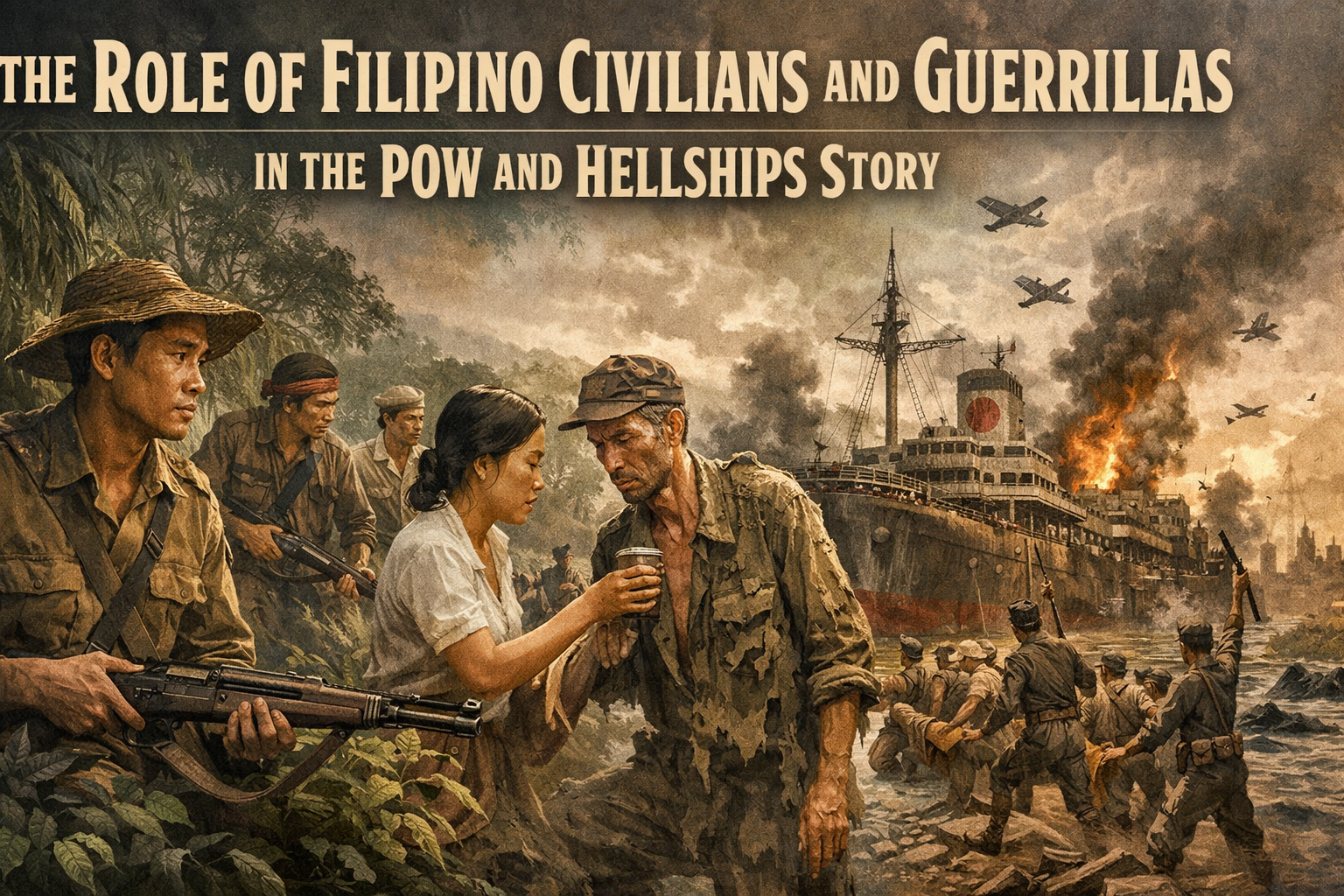
The Role of Filipino Civilians and Guerrillas in the POW and Hellships Story
The story of Allied prisoners of war in the Pacific is often told through the experiences of captivity—camps, forced labor, and transport aboard the Hellships. Less frequently examined is the role played by Filipino civilians and guerrilla fighters who, under conditions of extreme risk, provided assistance to these prisoners.
Across the Philippines, individuals and organized resistance groups acted in ways that helped sustain, protect, and, in some cases, liberate POWs. Their contributions form an essential but often understated part of the broader Hellships narrative.
Occupation and Resistance in the Philippines
Following the fall of the Philippines in 1942, the country came under Japanese occupation. While formal military resistance had ended, a wide network of guerrilla groups soon emerged.
These groups varied in size and organization, ranging from small local bands to larger coordinated units. Many maintained contact with Allied command structures and operated across Luzon, the Visayas, and Mindanao.
At the same time, civilians—farmers, traders, clergy, and ordinary families—continued their daily lives under occupation, often navigating a complex and dangerous environment.
Civilian Assistance to POWs
Filipino civilians played a direct role in supporting prisoners of war, particularly in areas near camps and transport نقاط.
Forms of assistance included:
Providing food and water
Smuggling medicine into camps
Passing information between prisoners and resistance groups
Offering shelter to escapees
These actions were carried out despite severe penalties. Japanese authorities imposed strict controls, and those caught aiding prisoners could face imprisonment, torture, or execution.
In many cases, assistance was informal and decentralized—small acts carried out by individuals rather than coordinated operations. Yet collectively, these efforts had a meaningful impact on prisoner survival.
Guerrilla Networks and Organized Support
Guerrilla groups provided a more structured form of assistance.
Their activities included:
Gathering intelligence on camp locations and movements
Coordinating escape routes
Conducting raids or rescue operations in specific circumstances
Communicating with Allied forces about POW conditions
Some units developed detailed knowledge of Japanese positions and logistics, which proved valuable both for local operations and for broader Allied strategy.
Guerrilla forces also served as intermediaries between civilians and prisoners, helping to organize and direct aid more effectively.
Assistance During POW Transfers
The movement of prisoners—whether between camps or toward embarkation points for Hellships—created additional opportunities for intervention.
During marches or transfers:
Civilians sometimes provided food along routes
Guerrillas monitored movements and reported on conditions
In rare cases, escape attempts were facilitated
These moments were particularly dangerous, as guards were often alert and security was heightened. Even so, assistance continued where possible.
Risk and Consequences
The risks associated with aiding POWs were significant.
Japanese occupation forces enforced strict control measures, including:
Surveillance of local populations
Collective punishment policies
Severe penalties for resistance activities
Individuals suspected of helping prisoners could be detained or subjected to harsh interrogation. Entire communities could be affected by reprisals.
Despite these risks, assistance persisted, reflecting both humanitarian motivations and broader resistance to occupation.
Impact on POW Survival
While it is difficult to quantify precisely, civilian and guerrilla assistance contributed to the survival of many prisoners.
Supplemental food reduced the effects of malnutrition
Information sharing improved awareness of conditions
Escape support allowed some prisoners to avoid further captivity
These contributions were not always visible in official records, but they are frequently noted in survivor accounts.
Postwar Recognition
After the war, recognition of Filipino contributions took various forms, including military acknowledgments and historical documentation. However, many individual acts of assistance were never formally recorded.
In recent years, there has been increased attention to the role of local populations in supporting POWs. This has helped bring greater visibility to a dimension of the war that was previously underrepresented.
Connection to the Hellships Story
The role of Filipino civilians and guerrillas is closely linked to the Hellships narrative.
Before prisoners were transported, they often passed through areas where local assistance was possible. In some cases, aid provided during this phase may have influenced who survived long enough to be transported—or who avoided transport altogether.
Understanding this connection adds depth to the overall history, showing that the experience of POWs was shaped not only by their captors, but also by those who sought to help them.
Conclusion
The experiences of Allied POWs in the Pacific cannot be fully understood without acknowledging the role of Filipino civilians and guerrilla fighters. Their actions—often carried out quietly and at great personal risk—represent an important aspect of the historical record.
By documenting these contributions, it becomes possible to present a more complete and balanced account of the Hellships story—one that includes not only suffering, but also acts of assistance and resistance.
You may be interested in: