

PT-31: Loss, Survival,
and the Long Aftermath
How the loss of one small PT boat off Bataan became a story of disappearance, endurance, and the wider collapse of the American defense in the Philippines.
A Fragile Weapon in a Failing Defense
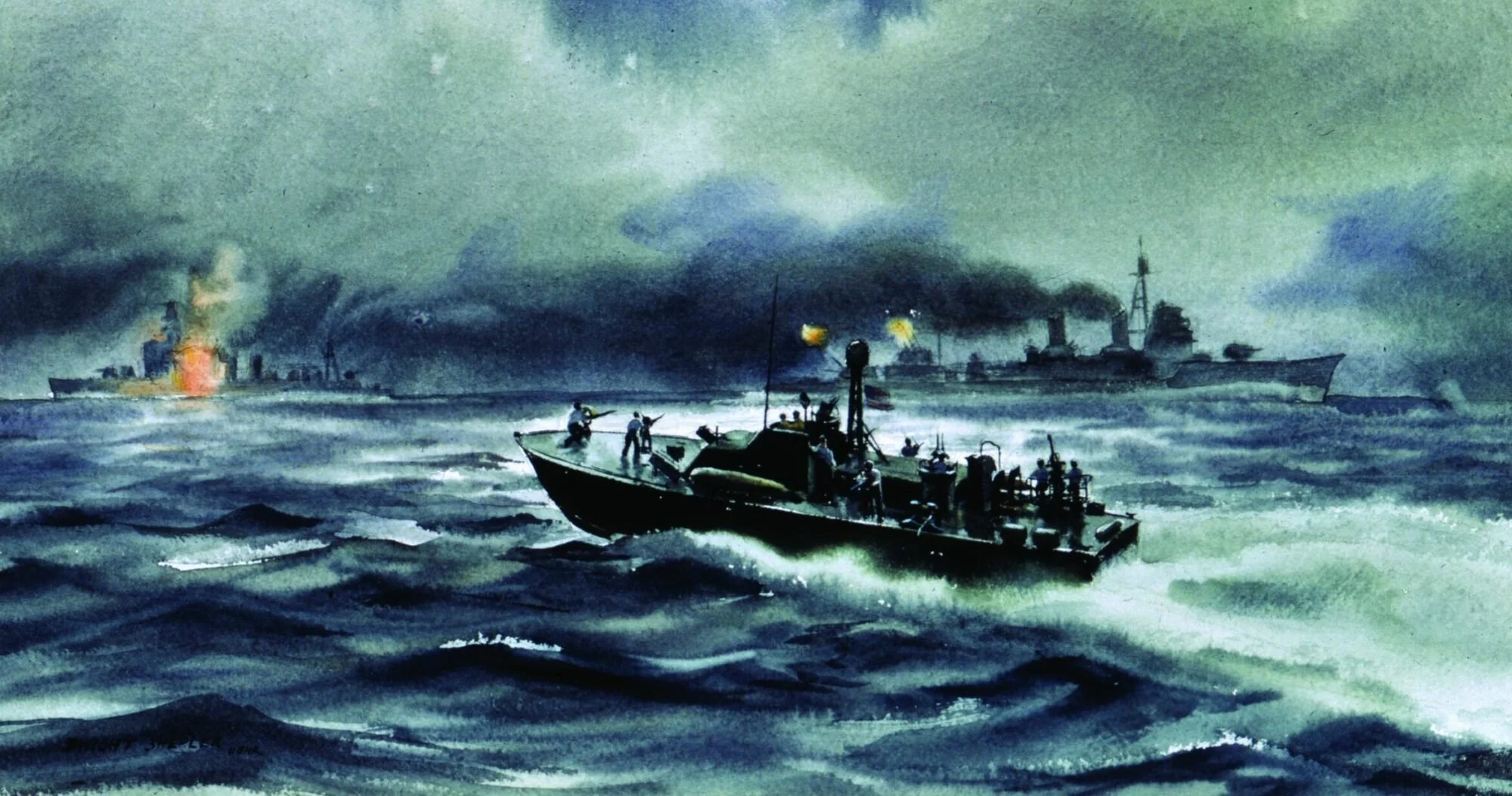
In the autumn of 1941, PT-31 was one of the small, fast, experimental craft that embodied a new kind of naval warfare, a 77-foot Elco motor torpedo boat built for speed, surprise, and the close-in violence of night attack rather than the heavy-gun duels that had long defined sea combat. She had been laid down on 13 March 1941, launched on 2 June, completed on 8 July, and soon found her way into the tense prewar buildup in the Far East, joining Motor Torpedo Boat Squadron 3 after shipment toward the Philippines in August 1941. By September, she was operating from Cavite Navy Yard, one of only a handful of American PT boats in the islands, part of a force so small that its very existence suggested improvisation rather than settled doctrine.
When war came to the Philippines in December 1941, PT-31 entered action in a theater already collapsing under the weight of Japanese air and sea power. The men of Motor Torpedo Boat Squadron 3 operated under conditions that would have broken a better-supplied force: spares were scarce, gasoline was precious, repair facilities were improvised, and every patrol demanded that exhausted engines keep running in waters increasingly controlled by the enemy. In the Philippines, they became weapons of necessity, sent out at night to probe landing areas, harass shipping, and sustain the illusion that the defenders still possessed a mobile striking arm.
PT-31 lived this hard life from the start of the campaign. The squadron was first based at Cavite and later worked out of the increasingly desperate network of anchorages and support points around Bataan and Corregidor, where the boats were expected to remain offensive even as the logistical foundations of the defense disappeared. By early January, the fall of Manila and the withdrawal into Bataan had compressed the last organized resistance into a shrinking enclave under constant pressure, and every PT patrol had become both mission and gesture of defiance .
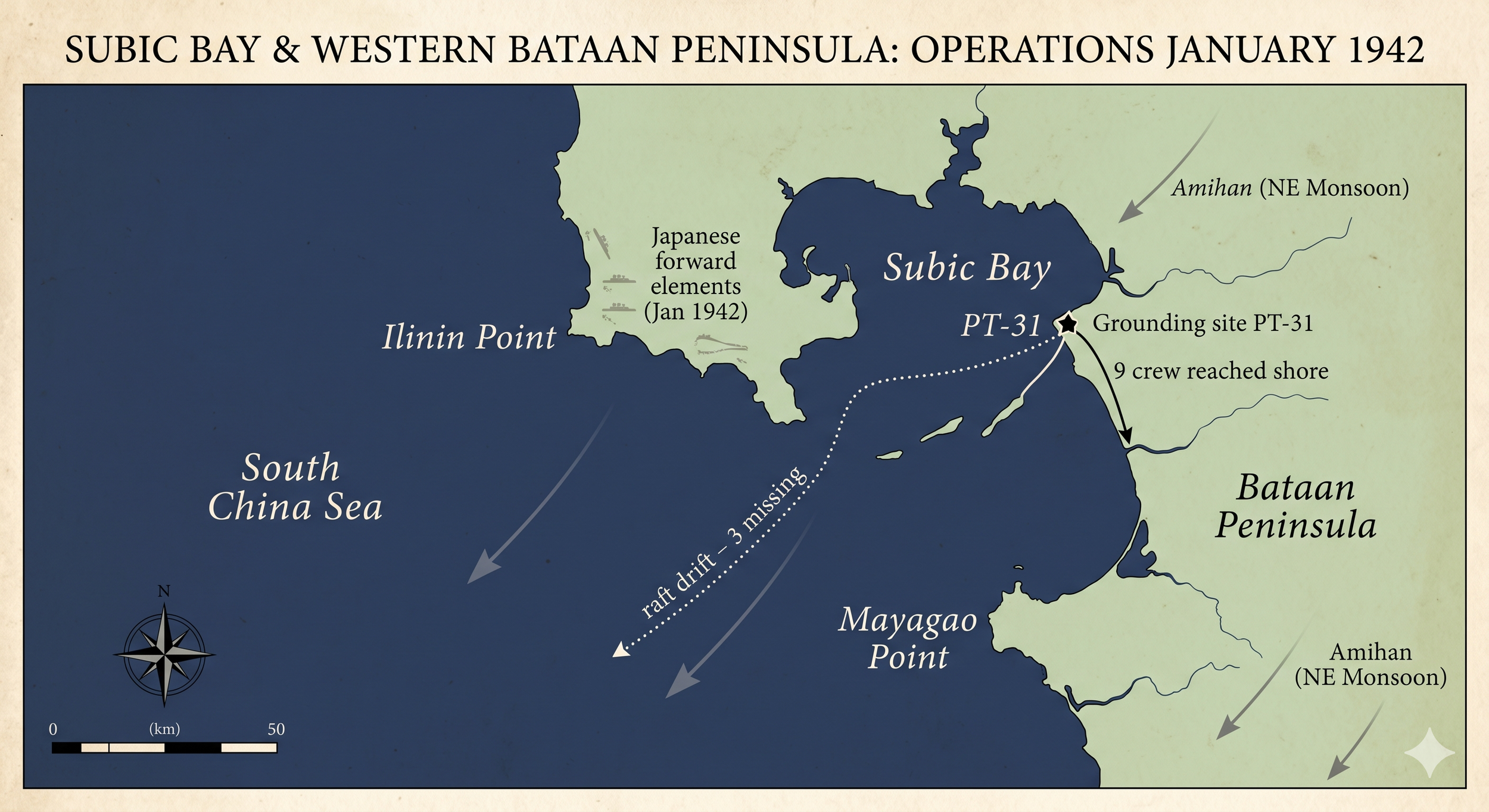
By mid-January, the condition of the boats had become a serious concern. Fuel contamination and wax deposits repeatedly clogged strainers and damaged performance, while overused machinery and combat conditions ensured that no sortie could be considered routine. Yet PT-31 was still sent out on the night of 18 January 1942, paired with PT-34 for an aggressive mission into the waters around Subic Bay and Binanga Bay on the northwestern side of Bataan, where Japanese shipping had been reported. PT-34, under Ensign Barron W. Chandler with Lieutenant John D. Bulkeley aboard, was to creep along one side of the bay, while PT-31, commanded by Lieutenant Edward G. DeLong, was to move along the eastern side of Subic Bay and rendezvous near the entrance to Binanga Bay.
Fire on the Reef
It was the sort of mission for which PT boats had been imagined: stealthy, nocturnal, daring, and close to shore. It was also the sort of mission most likely to expose every weakness of a worn-out craft operating in unfamiliar darkness under enemy observation. PT-34 managed to continue the operation, but PT-31 almost at once fell victim not to Japanese ships, but to machinery and geography.
According to the wartime narrative later published in At Close Quarters, PT-31 had scarcely begun her slow patrol along the eastern shore of Subic Bay before the now-familiar wax deposit clogged the strainers of both wing engines, while the center engine’s fresh-water cooling system became airbound. Helpless and drifting, she grounded on a reef near Mayagao Point on the Bataan side of the bay, in the vicinity of Ilinin Point, where a Japanese 3-inch gun opened fire on the stranded boat. The calm, precise language of the operational record from the Naval History and Heritage Command reduces the outcome to a single line, “PT-31 destroyed to prevent capture, Subic Bay, Philippine Islands, 19 Jan. 1942,” but that compressed entry conceals hours of frustration, danger, and steadily narrowing choices.
Lieutenant DeLong tried to save the boat. He walked out the anchor and repeatedly attempted to back PT-31 off the reef, but after roughly three hours of effort the reverse gears burned out and the boat remained firmly aground under enemy threat. It was a bitter kind of loss: a small combatant immobilized by maintenance failures in hostile waters, her crew forced to convert instantly from attackers into castaways.
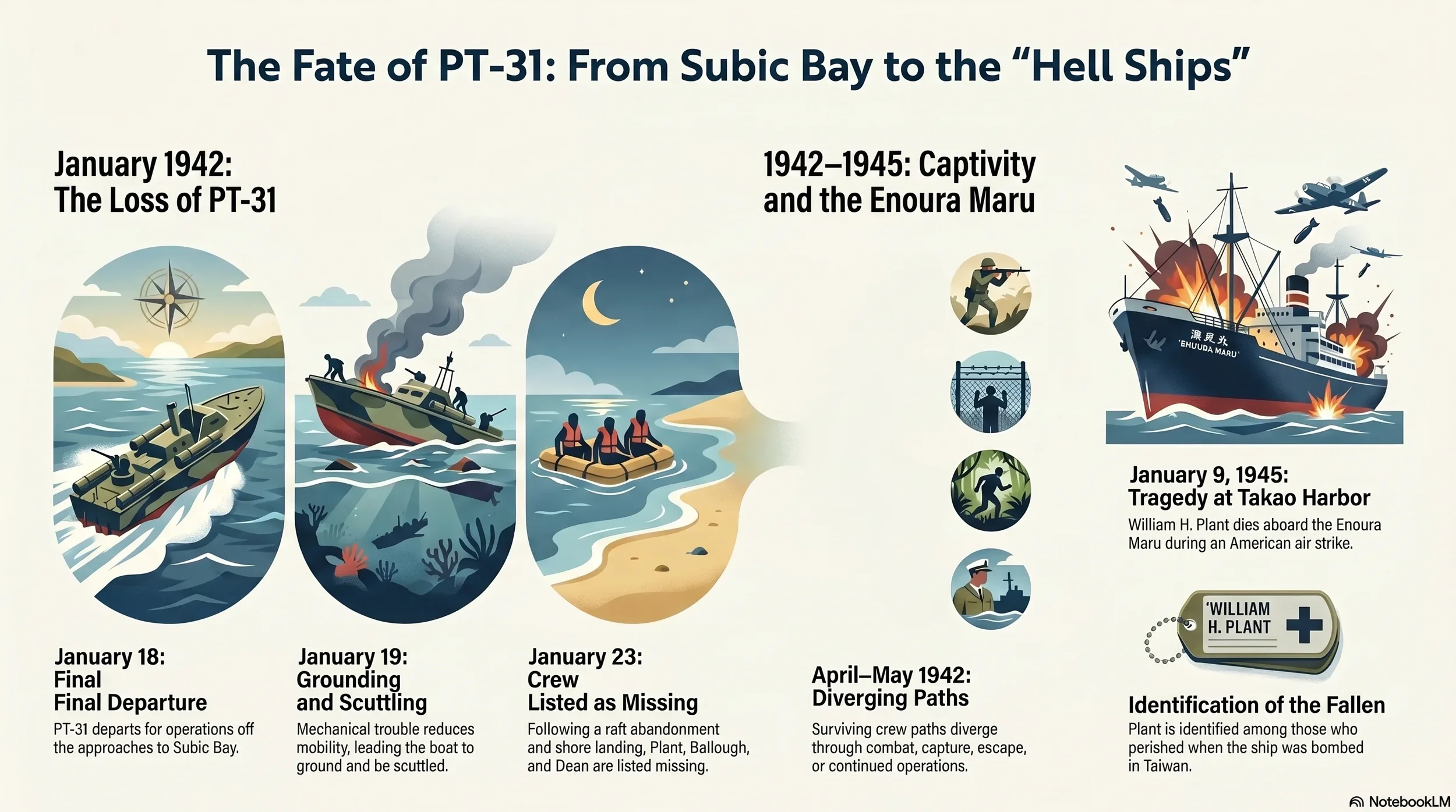
Once it became clear that PT-31 could not be saved, DeLong gave the order to abandon ship . The crew improvised a raft from the engine-room canopy, lashing mattresses to it so that it could float, a detail so makeshift and desperate that it captures the physical reality of the moment better than any grander language could. Ensign William H. Plant, the second officer, shoved off on this raft with the eleven men of the crew, while DeLong remained behind to scuttle the boat and deny it to the Japanese. He chopped holes in the gasoline tanks, damaged the hull with hand grenades, and set the vessel afire, then entered the water himself as PT-31 burned and exploded behind him on the reef.
The Missing Three
For an hour and a half, DeLong tried to locate the raft in the darkness while his boat burned, a solitary struggle that marks the emotional center of the story. At last, he crossed the reef to the beach and, shortly after dawn, found tracks in the sand leading south for half a mile. Following them to a clump of bushes, he discovered nine of his crew hiding among the bushes. But three were missing: Ensign William H. Plant, Machinist’s Mate First Class Rudolph Ballough, and Quartermaster Third Class William R. Dean. The wartime account is blunt and final: they were never seen again.
That sentence, simple as it is, gives PT-31 its lasting place in the history of the Philippine campaign. Many vessels are remembered for the violence of their end, but PT-31 is remembered for disappearance, for the uncertainty that opened in darkness between a burning boat and a hostile shore. Plant had taken charge of the raft, and the final moments of Ballough and Dean unfolded under circumstances no surviving witness could later reconstruct with confidence. Whether they were separated in surf, swept away, struck while trying to land, or lost in some other way near shore, the older historical record did not resolve the question. A more recent Naval Institute account suggests a harsher and more specific end, stating that nine sailors swam off the drifting raft to the beach, while the three who remained with it were later captured by the Japanese and did not survive the war.
The survivors, meanwhile, still had to escape. They waited through the day, located a pair of abandoned bancas, and resumed the movement toward friendly positions under the pressure of enemy proximity and the wider catastrophe unfolding across Bataan. By dawn on 20 January they reached the vicinity of Napo Point, and with help from Philippine Army soldiers were brought into contact with Captain George H. Cockburn of the 91st Infantry Division’s 92nd Infantry Regiment, 2nd Battalion, before arriving at Mariveles later that day. This movement from wreck to beach, from bushes to banca, and from banca to friendly lines gave the survivors a future, but it also confirmed that the three missing men were gone.
From Mariveles Back to War
Yet Mariveles was not the end of the story for Edward G. DeLong and the nine men who came ashore with him from the wreck of PT-31, but only a brief pause between one ordeal and the next. After the exhausted party landed near Napo Point in the early hours of 20 January, Philippine Army troops identified them, took them to Captain Cockburn, fed them, and arranged transportation back to Mariveles, where they arrived that same afternoon. Only hours earlier, they had been hiding in bushes beneath Mayagao Point, listening to Japanese soldiers move nearby and wondering whether daylight would expose them before they could steal the bancas that carried them to safety.
But the Philippines in January 1942 offered no true refuge, only narrower circles of danger. Motor Torpedo Boat Squadron 3 was still fighting out of the last shrinking perimeter around Bataan and Corregidor, and DeLong, having lost his own boat, returned almost at once to the work of a force already being consumed by exhaustion, mechanical decay, and the relentless pressure of the Japanese advance. His survival on the reef did not release him from the campaign; it merely sent him back into it on borrowed time.
Within days, he was at sea again. On the night of 24 January, Bulkeley and DeLong returned to Subic Bay in PT-41, and there, in the same hostile waters that had claimed PT-31, they crept into a cove near Sampaloc Point and launched a torpedo attack on what appeared to be an enemy transport. Under heavy return fire and the opening of shore batteries, the little boat zigzagged clear by the narrowest of margins, escaping an obstruction net at the mouth of the cove by only a few yards.
A week later, on the night of 1 February, DeLong was again in action, this time aboard PT-32 as officer in tactical command during another patrol off Bataan, trying to close with a larger Japanese vessel in darkness and under searchlight fire.
These later operations matter because they show that DeLong’s story did not flow directly from the loss of PT-31 into surrender and captivity. His posthumous Navy Cross later cited his service in hazardous operations in the Manila Bay area from 25 February through 10 April 1942, a span that carried him almost to the collapse of Bataan itself. The man who had swum away from a burning PT boat and led nine survivors through enemy-held shorelines was still fighting weeks later in a campaign that had already become hopeless in every material sense and yet somehow still demanded nightly courage from the men ordered to continue it.
Bataan and Beyond
Around him, the world of Bataan was disintegrating. Food had been cut, disease was everywhere, and the defenders were being ground down by bombardment, hunger, and the knowledge that relief would not come 9 April 1942, the peninsula finally surrendered, and from that surrender emerged one of the most infamous episodes of the Pacific war, the Bataan Death March, in which tens of thousands of American and Filipino prisoners were driven toward Camp O’Donnell under conditions of starvation, thirst, beating, torture, and casual murder.
It is here that the historical trail divides, and the continuation becomes less clean than legend might prefer. For the nine men who had escaped with DeLong from the beach below Mayagao Point, the open public record reviewed here does not yet provide a full named accounting of who was captured on Bataan, who may have entered the Death March, who reached later prison camps, or who perhaps found another path through the chaos of the Philippines campaign. The broad campaign history makes clear that most remaining Navy personnel in the theater became prisoners of war, while a smaller number escaped and joined guerrilla resistance or attempted to move south toward still-unoccupied islands. The nine survivors of PT-31 vanished into that wider catastrophe unless and until their individual records are traced through rosters, casualty files, or next-of-kin correspondence.
DeLong’s own fate, however, appears to have followed a different and even more tragic course. The best-named biographical sources located for him indicate that he did not simply fall into the Bataan prison system after the surrender, but instead continued moving through the islands and eventually attempted to escape by native boat with another officer.
According to the Navy Department letter quoted in his memorial biography, the escape failed when the pair were captured on Bangka Island in the North Celebes, taken to Manado, and executed by the Japanese on 2 July 1942, after which they were buried in a common grave. That account moves the last chapter of his life far beyond the beaches of Bataan into the wider geography of defeat, evasion, capture, and murder that marked so many lesser-known endings in the early Pacific war.
The Scattering of the Crew
In that sense, the story of PT-31 did not end when the boat burned on the reef north of Mayagao Point. It continued through DeLong’s return to Mariveles, his later patrols in other boats, the ruin of Bataan, and then outward into the fractured aftermath of surrender, when some men were driven into the Death March, some disappeared into prison camps, some tried to escape, and some were killed long after the front itself had collapsed.
There is also a final sadness in the way the record preserves some names sharply and blurs others. Plant, Ballough, and Dean were lost first, on the dark water after the raft pushed off from the wreck of PT-31, and later sources now suggest that the three men who stayed aboard the raft were captured by the Japanese and did not survive the war, though older narratives had only been able to say that they were never seen again. DeLong and the nine swimmers survived that first separation, but survival in the Philippines in 1942 was often only a postponement, not a deliverance.
So the continuation of PT-31’s story is not merely one more episode of escape, but the descent from combat into defeat and then into the harsher world that followed defeat.
DeLong came back from the reef and fought on, only to die months later in Japanese hands far from the boat he had commanded. The nine men who crouched with him in the underbrush below Mayagao Point passed from the intimate, visible drama of PT-31’s loss into the immense and often impersonal suffering that followed the fall of Bataan. That is perhaps the truest ending to the story: not a single clean conclusion, but the scattering of one crew into the different kinds of loss the first months of the Pacific war could inflict.
Selected Sources
https://pacificwrecks.com/ship/ptboat/PT-31.html
https://www.ibiblio.org/hyperwar/USN/CloseQuarters/PT-1.html
https://www.usni.org/magazines/naval-history/2024/december/earning-glory-forlorn-defense
https://usnamemorialhall.org/index.php/EDWARD_G._DELONG,_LT,_USN
https://history.santacruzpl.org/omeka/items/show/4367