

The Evolution of the
US Navy PT Boat
Historical Genesis: From Displacement to Planing Hulls
The development of the Patrol Torpedo (PT) boat represented a paradigm shift in naval architecture, transitioning from the heavy displacement hulls of the late 19th century to the high-performance planing hulls of World War II. Early torpedo boats were essentially scaled-down destroyers, displacing up to 300 tons with speeds limited to 25–27 knots. These vessels relied on sheer engine power to push through the water, constrained by the physics of displacement.
In contrast, the WWII-era PT boat utilized a planing hull designed to skim the surface, significantly reducing drag. A pivotal benchmark in this evolution was W. Albert Hickman’s "Sea Sled" design. His privately financed 41-foot sea sled demonstrated exceptional seakeeping in 1915, and a later model, the C-378, achieved 37 knots. Most notably, the Sea Sled maintained an average speed of 34.5 knots in a winter northeaster with 12-to-14-foot seas, a performance metric that remains exceptional.
The American PT program was further catalyzed in February 1939, when an Elco delegation consisting of Henry Sutphen, Irwin Chase, Bill Fleming, and Glenville Tremaine visited the British Power Boat Company. They purchased Hubert Scott-Paine’s 70-foot private venture design (PV70), which was brought to the U.S. and designated PT-9. This vessel served as the technological progenitor for the early Elco designs.
Engineering the "Mosquito Fleet": Technical Specifications of the PT-20 Class
The USS PT-31 was a primary model of the Elco 77-foot class (PT-20 series), engineered for high-speed littoral combat. The vessel's construction utilized double-planked mahogany, providing a balance of strength and flexibility.
PT-31 Technical Profile
Builder: Elco (Electric Boat Company), Bayonne, NJ
Length Overall : l 77 feet
Beam: 19 feet 11 inches
Draft: 5 feet 6 inches
Displacement (Standard): 35 tons
Displacement (Full Load): 56 tons
Hull Material: Double-planked Mahogany
Complement: 12 to 17 Officers and Men
Propulsion System: PT-31 was powered by three supercharged Packard 4M-2500 liquid-cooled, gasoline-fueled V-12 marine engines. The configuration utilized a V-drive system for the two outboard engines and a direct-drive system for the center engine.
Emergency Output: 4,500 total Brake Horsepower (BHP) at 2,500 RPM.
Continuous Output: 2,850 total BHP at 2,000 RPM.
Electrical and Communication Infrastructure
Internal operations were governed by Bureau of Ships (BuShips) mandated systems to ensure coordination amidst engine noise and combat stress:
Sound Powered Telephone Cabinet (9-S-5134-L): Maintained internal voice loops.
Emergency Ignition Switch Box (9-S-5604-L): Facilitated immediate engine cut-off.
Light Machine Gun Cease Firing Signal (9-S-5517-L): Coordinated defensive fire from the .50-caliber mounts.
Voice Tubes (9-S-4664-L): Provided manual backup for verbal commands.
The 1941 "Plywood Derby": Determining the Standard
In July and August 1941, the Board of Inspection and Survey conducted comparative service tests off New London, CT. Known as the "Plywood Derby," these trials aimed to identify the superior hull for mass production.
Performance Comparison
Boat Model: Elco 77-footer (PT-20)
Max Speed (Avg): 39.72 knots
Speed (16-ft Seas): 27.5 knots
Pounding Tendency: Heavy / Severe
Boat Model: Higgins 81-footer (PT-6)
Max Speed (Avg): 31.40 knots
Speed (16-ft Seas): N/A
Pounding Tendency: Moderate
Boat Model: Huckins 72-footer (PT-69)
Max Speed (Avg): 33.83 knots
Speed (16-ft Seas): Withdrew (Failure)
Pounding Tendency: Very Little
Boat Model: Philadelphia Navy Yard (PT-8)
Max Speed (Avg): 30.75 knots
Speed (16-ft Seas): 24.8 knots
Pounding Tendency: Least Pounding
Note: PT-8 utilized an aluminum hull and was deemed overweight, necessitating a post-test weight reduction.
Findings and Structural Integrity
The Board noted that the Elco 77-footers exhibited structural weaknesses, specifically transverse fractures of the deck planking. However, due to its overall speed and versatility, the Elco design was approved for future production pending hull strengthening. Critically, the Board recommended the Packard 4M-2500 be adopted as the standard power plant for all future PT boat construction.
Armament and Offensive Systems
The PT-31 was equipped for heavy anti-surface strikes and secondary defense.
Primary Armament: Two 21-inch deck-mounted torpedo tubes.
Ordnance: Mk 8 torpedoes, which were launched using a small black powder charge.
Technical Deficiencies: The Mk 8 torpedoes were notoriously unreliable. When set for the shallow depths required to hit thin-skinned transports, they were prone to "porpoising" (breaching the surface) and "circular runs," where the weapon’s gyro would fail, potentially leading it back toward the launching vessel.
Secondary Armament: Two twin .50-caliber Browning M2 heavy machine gun mounts for anti-aircraft and suppressive fire.
The Packard V-12: Powering the Plywood Fleet
The Packard V-12 marine engines were the mechanical heart of the U.S. PT boat fleet, chosen as the absolute standard for all future construction after proving "highly satisfactory" during the Navy's 1941 "Plywood Derby" trials.
Origins and Aircraft DNA These engines were liquid-cooled, gasoline-fueled marine derivations of aircraft engines, specifically evolving from Packard's World War I-era Liberty L-12 2A engine. The adaptation was partly pioneered in the interwar period by boat racer Garfield Wood, who modified vintage Liberty engines to maximize power while reducing weight for high-speed racing boats. As they were adapted for military marine use, the successive generations of the engine (designated "M" for marine) retained their aircraft origins, featuring superchargers, intercoolers, dual magnetos, and two spark plugs per cylinder.
A common historical misconception is that these boats were powered by Rolls-Royce Merlin engines. While Packard did manufacture Merlins under license during the war, American PT boats used the Packard 3A-2500 derivations; only the British-built PT-9 prototype, which the Electric Boat Company (Elco) purchased and copied, actually featured a Merlin engine.
Generations and Power Output The engines evolved through the 3M-2500, 4M-2500, and 5M-2500 generations, with each iteration offering greater speed and power:
The 4M-2500: This version initially generated 1,200 horsepower but was upgraded in stages to produce 1,500 horsepower, giving the boats a designed speed of 41 knots.
The 5M-2500: Introduced in late 1945, this final wartime generation featured an enlarged supercharger and an aftercooler, boosting the output to a massive 1,850 horsepower. It was capable of pushing fully loaded PT boats to speeds of 45 to 50 knots.
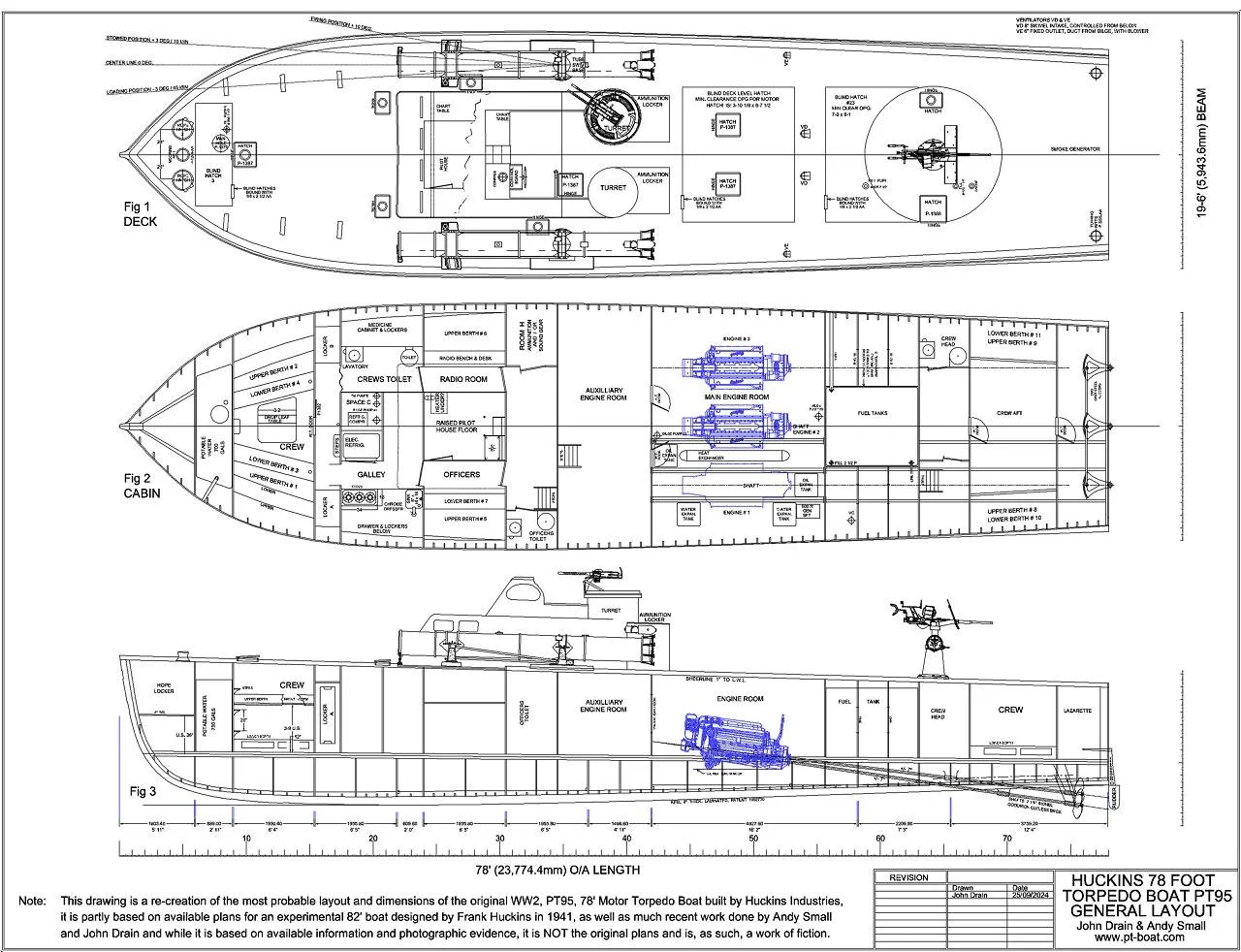
Unique Installation Configuration To fit three massive V-12 engines into the narrow engine room of a PT boat—along with generators, batteries, and other equipment—builders like Elco had to use a highly unorthodox configuration. The center engine was installed conventionally with a direct drive, but the two outer ("wing") engines were actually installed backwards. The thrust from these backward-facing outer engines was then reversed using a V-drive system to transmit power to the propeller shafts.
Extreme Fuel Consumption and Vulnerabilities The high performance of the Packard V-12s came at the cost of immense fuel consumption. PT boats were equipped with 3,000-gallon tanks filled with highly volatile 100-octane aviation gasoline, which provided a maximum patrol endurance of about 12 hours. At a cruising speed of 23 knots, the three engines consumed around 200 gallons per hour, but when running flat-out at top speed, consumption skyrocketed to up to 500 gallons per hour.
This reliance on aviation gasoline was a major tactical vulnerability; direct strikes from enemy fire often caused catastrophic gasoline explosions that completely obliterated the wooden boats.
Furthermore, the engines were notably finicky, high-maintenance beasts. They were supposed to be completely overhauled every 750 hours of operation. As demonstrated by the tragic fate of PT-31 in the Philippines, the engines were also highly vulnerable to poor or sabotaged fuel. Contaminants—such as the soluble wax introduced by fifth columnists in 1941—would easily clog their gas strainers and carburetor jets, causing the engines to stall without warning and leaving the boats helpless.
To fit three massive Packard V-12 engines, generators, batteries, and other essential equipment into the narrow engine room of a PT boat, builders utilized a highly unorthodox and complex mechanical configuration.
In this setup, the center engine was installed conventionally and was direct-driven to its propeller shaft. However, the two outer, or "wing," engines were installed completely backwards.
Because these outboard engines faced the opposite direction, their thrust had to be redirected to propel the boat forward. The V-drive system was used on these wing engines to reverse the direction of their thrust and transmit power to the propeller shafts. While this arrangement was absolutely essential for maximizing space within the cramped hull, it added mechanical complexity and increased the maintenance burden on the boat's mechanics.
To fit three massive Packard V-12 engines, generators, batteries, and other essential equipment into the narrow engine room of a PT boat, builders utilized a highly unorthodox and complex mechanical configuration.
In this setup, the center engine was installed conventionally and was direct-driven to its propeller shaft. However, the two outer, or "wing," engines were installed completely backwards.
Because these outboard engines faced the opposite direction, their thrust had to be redirected to propel the boat forward. The V-drive system was used on these wing engines to reverse the direction of their thrust and transmit power to the propeller shafts. While this arrangement was absolutely essential for maximizing space within the cramped hull, it added mechanical complexity and increased the maintenance burden on the boat's mechanics.
The V-Drive Architecture of Packard PT Boats
The primary advantage of the V-drive system was that it maximized space, allowing for a narrower engine room inside the PT boat.
By installing the two outboard (or "wing") engines completely backwards, builders were able to fit three massive Packard V-12 engines, along with generators, batteries, and other essential equipment, into the cramped constraints of the hull .
The V-drive system was then utilized on these backward-facing engines to reverse the direction of their thrust and transmit power to the propeller shafts, making this highly unorthodox but essential space-saving configuration possible .
Differences between the Elco and Higgins PT boats
The most prominent differences between the Elco and Higgins PT boats were their overall length and their early torpedo launch mechanisms. The Electric Boat Company (Elco) manufactured an 80-foot boat, which was the longest of the PT boats built for the U.S. Navy during World War II. In contrast, Higgins Industries produced a slightly shorter 78-foot boat. Additionally, on the early models equipped with Mark 8 torpedo tubes, Elco boats launched their torpedoes using a black powder charge, whereas Higgins boats utilized compressed air.
As the war progressed, the two companies experimented with different advanced design variations. Elco developed a stepped hull known as the "ElcoPlane" to achieve higher top speeds, while Higgins designed a small, fast 70-foot variation called the "Higgins Hellcat," which the Navy ultimately rejected for full production. Elco was also the primary manufacturer for the Navy, producing 326 boats compared to the 199 boats built by Higgins.
Despite these differences, the two designs were remarkably similar in their core specifications. The 78-foot Higgins boats featured the exact same 20-foot, 8-inch beam, full load displacement, trial speed, armament, and crew accommodations as the 80-foot Elco boats. Both designs shared several other key characteristics:
Propulsion: Both were powered by the same configuration of three Packard V-12 marine engines and generators.
Hull Shape: Both utilized a similar contoured "planing hull" shape featuring a sharp V at the bow that softened to a flat bottom at the stern, allowing them to skim the water at high speeds.
Construction: Both builders utilized lightweight construction techniques, building the hulls with two layers of mahogany planking separated by a layer of canvas (either glue-impregnated or lead-painted), all held together by thousands of copper rivets and bronze screws.