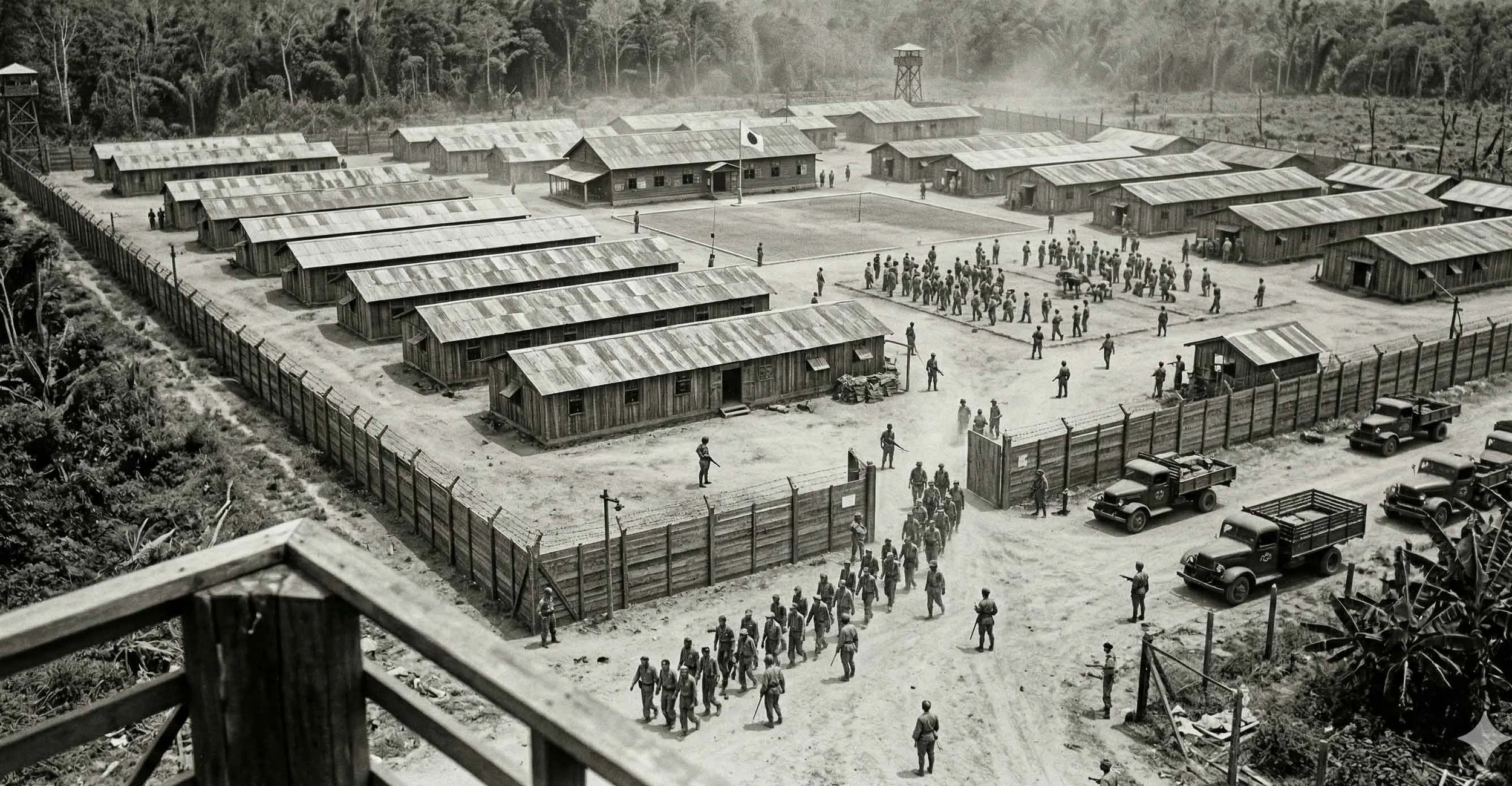
Cabanatuan Camp
The Camp of Survival
After the ordeal of the Bataan Death March, thousands of exhausted American and Filipino prisoners of war were transported to a new detention facility in the agricultural plains of central Luzon. There, near the town of Cabanatuan in Nueva Ecija, the Japanese established what would become the largest prisoner-of-war camp in the Philippines.
The prisoners arrived weakened by weeks of starvation, disease, and brutality. Many had already watched friends and comrades die along the road from Bataan. At Cabanatuan they hoped for rest and medical care. Instead, they entered another harsh chapter of captivity.
The camp consisted of bamboo barracks surrounded by barbed wire and guarded by Japanese soldiers. The ground was dusty in the dry season and muddy in the rains. Overcrowded buildings offered little protection from heat or insects. Food rations were meager—often just small portions of rice—while medicine and proper sanitation were scarce.
Life Inside the Camp
Daily life in Cabanatuan was marked by monotony, hunger, and illness. Prisoners struggled constantly with malnutrition and diseases such as malaria, dysentery, and beriberi. Medical supplies were extremely limited, and camp doctors were forced to improvise treatments using whatever materials they could find.
Despite these hardships, the prisoners organized themselves as best they could. Officers tried to maintain discipline and order. Medical staff established makeshift hospitals. Some prisoners taught classes or organized small religious services to maintain morale.
For many, survival depended on cooperation and ingenuity. Prisoners fashioned tools from scrap materials, shared food whenever possible, and supported those too weak to stand. Bonds formed under these desperate conditions that would last a lifetime.
A Prisoner’s Journey
For Sgt. William Mercer, the young American infantryman whose journey we follow through this story, Cabanatuan represented a strange mixture of relief and despair.
After weeks on the road during the Death March, the camp meant at least a temporary end to the constant beatings and forced marches. Yet the reality soon became clear: the war had not ended for them. They were prisoners deep inside enemy territory, uncertain whether they would survive the months—or years—ahead.
Mercer watched as men grew thinner with each passing week. Some who had survived Bataan succumbed to disease in the camp hospital. Others simply faded away from starvation and exhaustion.
But there were also moments of courage. Prisoners shared food, helped the sick, and whispered news whenever rumors of the war filtered through the camp. Each small act of solidarity strengthened their determination to endure.
The Largest POW Camp in the Philippines
Cabanatuan eventually held thousands of Allied prisoners, primarily Americans captured in the fall of Bataan and Corregidor in 1942. The camp complex actually consisted of several separate compounds that housed prisoners at different times during the war.
Over the years many prisoners were transferred from Cabanatuan to other locations. Some were sent to work details in the Philippines. Others were moved to Manila, where they would later be transported aboard Japanese ships bound for labor camps across the Japanese Empire.
Those ships would soon become known among the prisoners by a grim name: the Hellships.
The Road Continues
For Sgt. Mercer and many of his fellow prisoners, their time in Cabanatuan would not be the end of their captivity. In 1944, as the war in the Pacific intensified, the Japanese began moving prisoners from the Philippines to Japan and Formosa to perform forced labor.
Many of the men who had survived Bataan and endured years in Cabanatuan would soon be transferred to Bilibid Prison in Manila—the next step in a journey that would eventually lead them aboard the Hellships.
Continue the Journey