

Oryoku Maru
Cruise of Death: The True Story of the Oryoku Maru Hellship.
The sinking of Oryoku Maru marked the beginning of a terrible transport chain that continued through Enoura Maru and Brazil Maru, costing hundreds more lives before the surviving prisoners finally reached Japan .
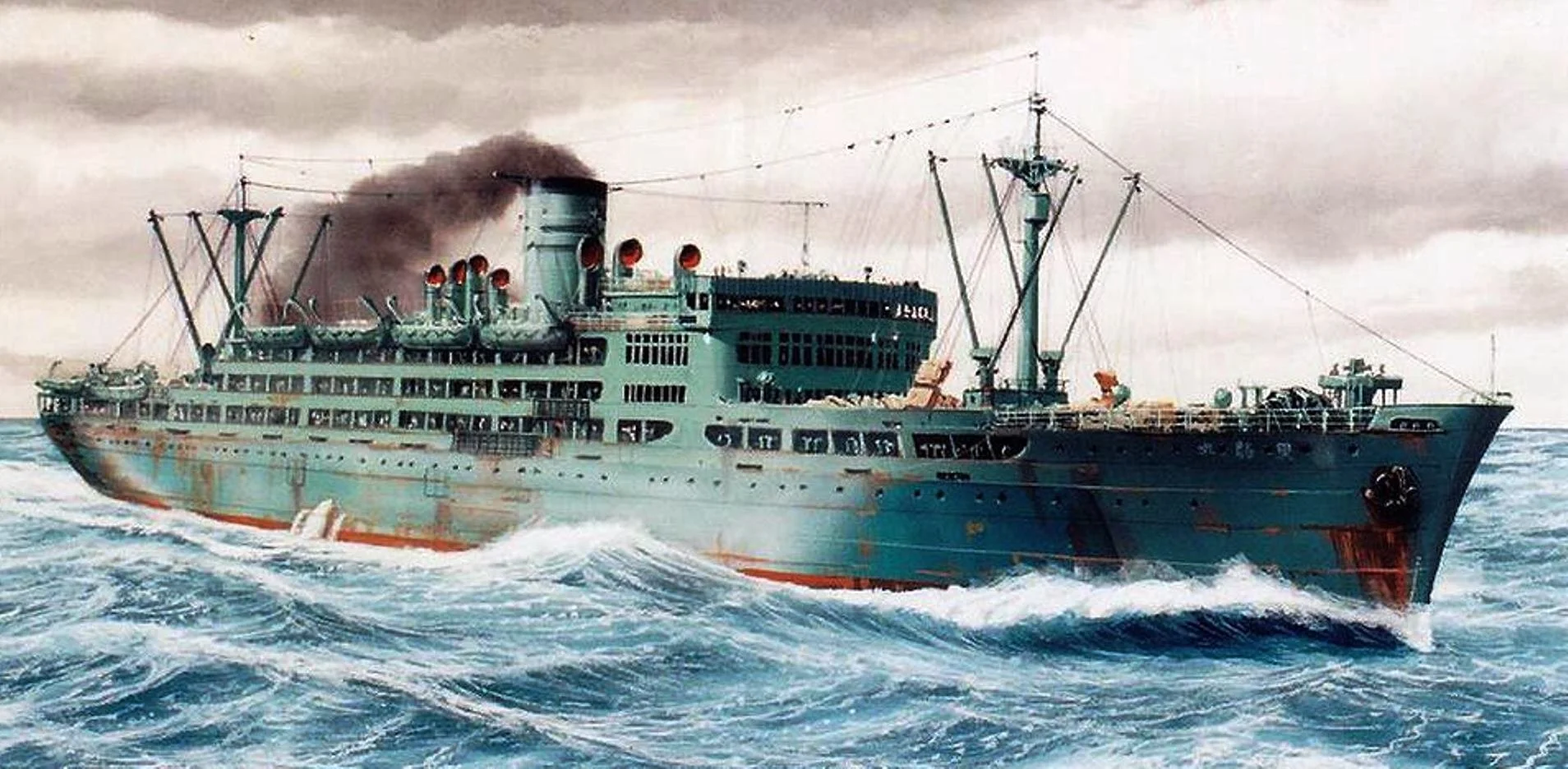
In December 1944, Oryoku Maru became one of the most tragic ships in the history of the Japanese Hellships. A Japanese passenger-cargo vessel pressed into wartime transport service, it left Manila on 13 December 1944 carrying more than 1,600 Allied prisoners of war, most of them Americans captured in the Philippines.
Two days later, while in Subic Bay, the unmarked ship was attacked by American carrier aircraft, unaware that Allied POWs were aboard.
Key facts
Built: 1937 by Mitsubishi Heavy Industries, Nagasaki
Owner: Osaka Shosen Kaisha (O.S.K. Line)
Tonnage: Approximately 7,369 gross tons
Type: Passenger-cargo ship, later military transport
Sunk: December 15, 1944, Subic Bay, Philippines. Technical Specifications
Length – 118 metres
Width – 17.4 metres
Draught – 10.5 metres
Displacement – 7363 tonnes
Engine – 4 x steam turbines, 2 x propellors
Power – 8255 horsepower
Speed – 18 knots
The Ship
Oryoku Maru was originally a Japanese passenger-cargo ship later used by the Japanese military as a transport vessel during World War II. Like many other Japanese prison transports, it was not marked to show that it carried Allied prisoners of war. This failure to identify POW transports left the ship vulnerable to attack by American aircraft and submarines operating against Japanese shipping. In later memory, Oryoku Maru became one of the best-known of the wartime “Hellships,” a term used by survivors to describe the appalling conditions aboard these transports.
The Final Voyage
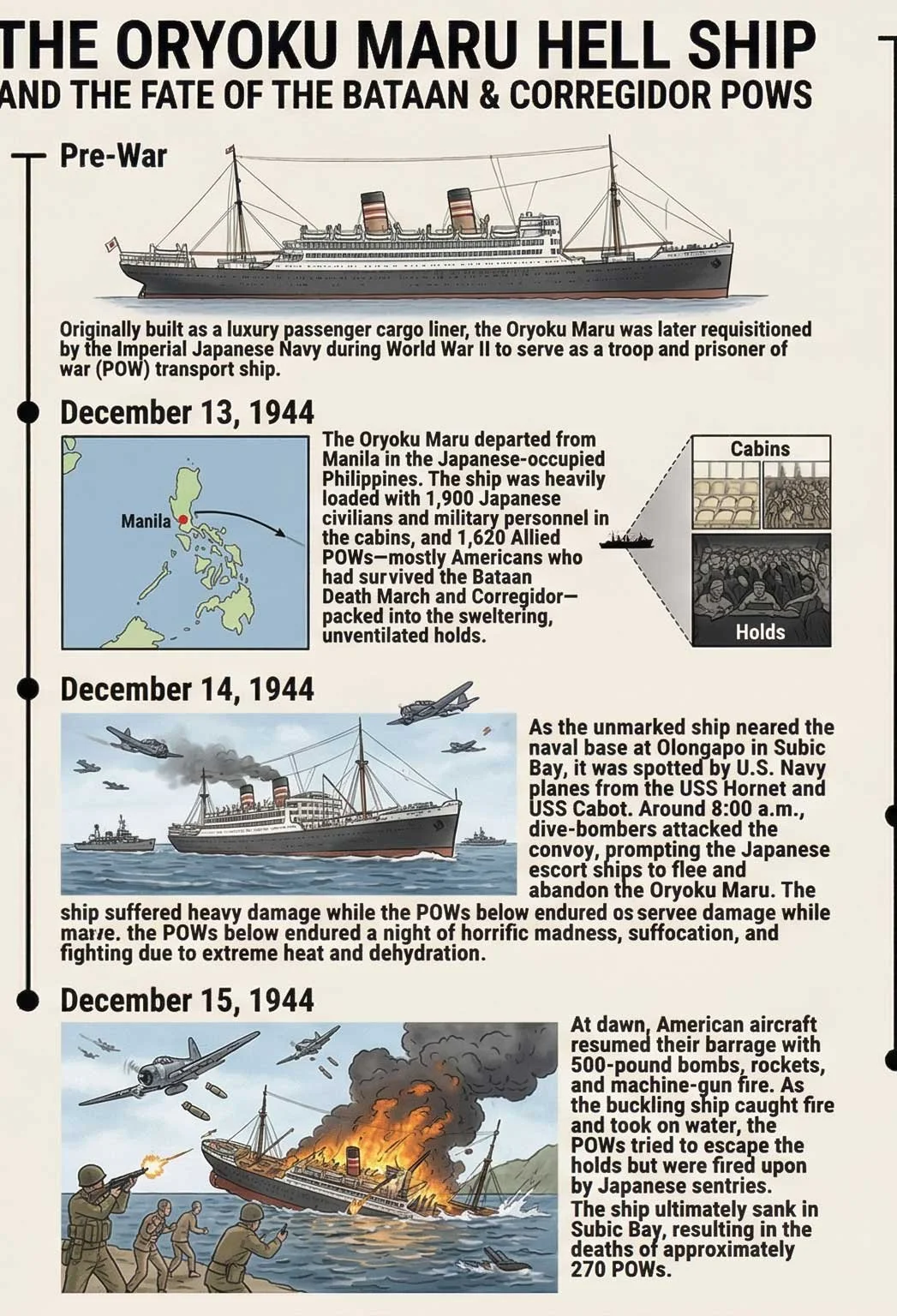
On December 13, 1944, the ship departed from Manila in the Japanese-occupied Philippines, carrying 1,900 Japanese civilians and military personnel in the relative comfort of its cabins. Below decks, however, the reality was a nightmare. Packed into the stifling, unventilated holds were 1,620 Allied POWs. This group consisted predominantly of American soldiers—many of whom were already severely weakened survivors of the 1942 Bataan Death March and the battles of Corregidor—alongside British, Dutch, Czech, and Norwegian prisoners. The conditions inside the holds defied human endurance.
According to survivor Lieutenant Colonel O. O. Wilson, the men were forced into wooden bays measuring seven by eight feet, with twenty men crammed into each tier. To fit, the prisoners had to sit interlocked, jammed into the crotches of the men behind them. The remaining space was filled with standing men packed shoulder-to-shoulder, completely cutting off the air supply. The heat quickly reached 110 degrees, and men were instantly bathed in sweat, suffering from severe dehydration and suffocation. The absolute darkness and agonizing thirst drove many men completely mad. Deadly fights erupted in the sewage-filled holds; some desperate prisoners drew knives to kill others so they could drink their blood, while others swung canteens filled with urine in the pitch black.
The Fatal Attack
The suffering aboard the Oryoku Maru was soon interrupted by a violent twist of fate. Intercepted Japanese radio transmissions had provided Allied intelligence with the locations of Japanese shipping movements, though the presence of POWs aboard these vessels was largely unknown to the attacking ship and submarine commanders. On December 14, as the unmarked Oryoku Maru neared the naval base at Olongapo in Subic Bay, aircraft from the USS Hornet and USS Cabot spotted the convoy and launched a fierce attack. The ship's escort vessels quickly abandoned the Oryoku Maru , fleeing the scene and leaving it to face the dive-bombers alone. As bombs struck the ship, panic erupted in the holds.
Desperate prisoners attempted to climb the steep ladders to the main deck, but the Japanese guards indiscriminately fired their weapons down the hatches to drive them back into the darkness. The aircraft returned the next morning, unleashing a devastating barrage of 500-pound bombs, rockets, and machine-gun fire that buckled the ship's girders and ignited massive fires. As the waters rose in the flooding holds, the prisoners were forced up through the hatches and into the inferno, where Japanese sentries shot them dead as they tried to abandon ship. Ultimately, the chaos and flames became too intense, forcing the Japanese jailors to flee. Approximately 270 POWs died aboard the vessel, either from suffocation and dehydration in the holds, being killed in the bombings, drowning, or being shot by guards.
Casualties and Survivors
For the surviving POWs who managed to swim ashore or were captured in the water by the Japanese, the nightmare was far from over. They were herded onto an open-air tennis court at the Olongapo Naval Base, where they were held for several days. The Japanese provided absolutely no sanitary conditions, and the severely weakened survivors experienced continuous, severe mistreatment, leading to several more deaths on the court. Eventually, the prisoners were moved to the municipality of San Fernando in the province of Pampanga.
It was here that one of the most callous atrocities of the ordeal took place. A group of fifteen sick and wounded prisoners were separated from the main group and loaded onto a truck. The Japanese guards explicitly told the prisoners that they were being transferred to Bilibid Prison in Manila to receive desperately needed medical treatment. This was a cruel deception. Instead of driving to a medical facility, the truck transported the fifteen incapacitated men to a nearby cemetery. There, Japanese guards systematically beheaded every single one of them and unceremoniously dumped their bodies into a mass grave.
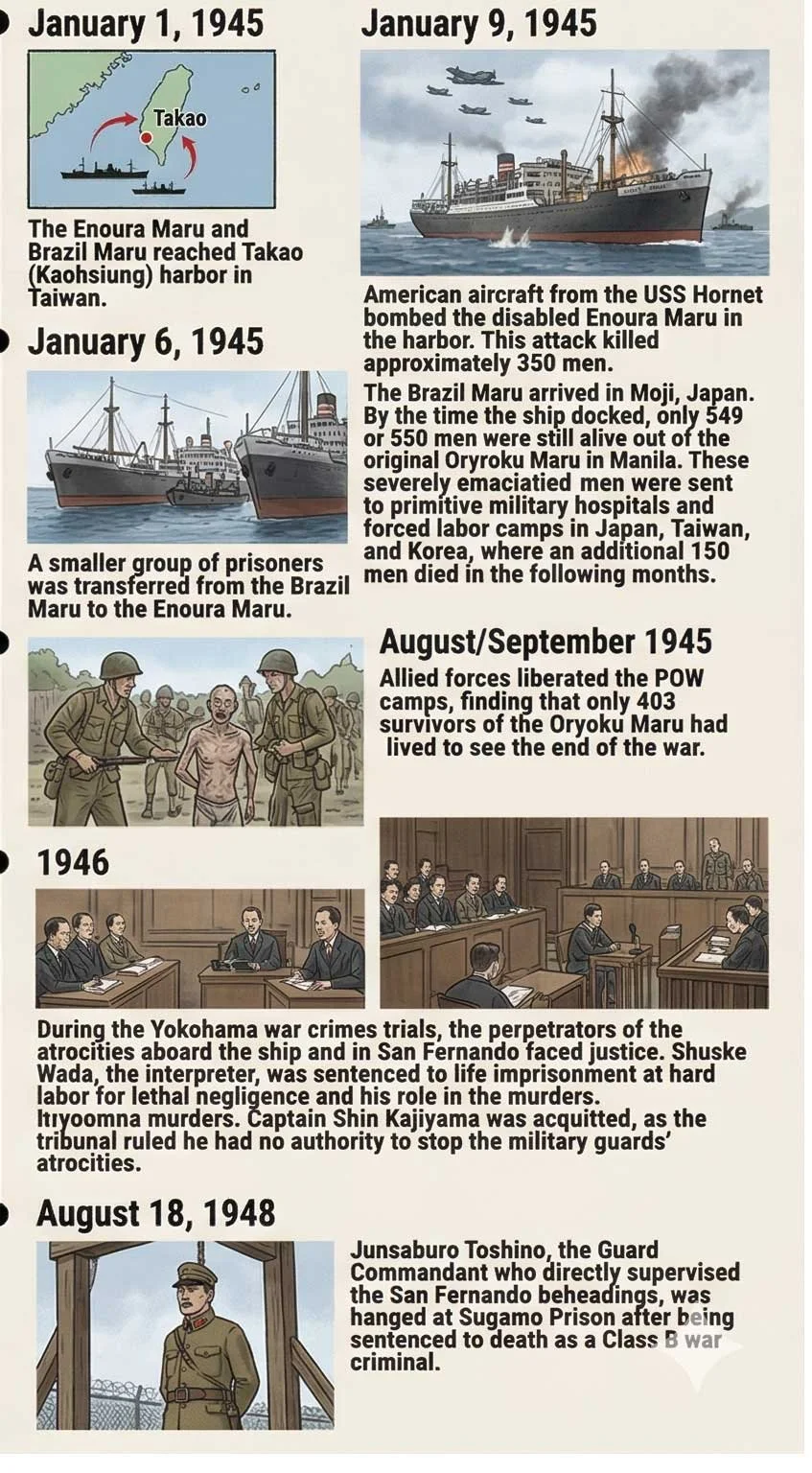
The prisoners who survived the massacre and the horrific conditions in San Fernando were still far from safety. The remaining POWs were loaded onto a train and transported to San Fernando, La Union. From there, they were forced aboard two more hell ships to continue their grim journey north: the Enoura Maru and the Brazil Maru. These ships reached Takao (Kaohsiung) harbor in Taiwan by New Year's Day, 1945.
Tragedy struck yet again on January 9, when American aircraft bombed the disabled Enoura Maru in the harbor, killing approximately 350 more men. The surviving prisoners were consolidated onto the Brazil Maru, which finally arrived in Moji, Japan, on January 29, 1945. By the time the ship docked, the Japanese medics were visibly shocked by the wasted, skeletal condition of the prisoners. Of the 1,620 men who had originally boarded the Oryoku Maru in Manila, only about 550 were still alive. Over the following months, another 150 men succumbed to starvation, disease, and exposure in primitive military hospitals and forced labor camps scattered across Japan, Taiwan, and Korea. Ultimately, when Allied forces liberated the camps in August and September 1945, only 403 survivors of the Oryoku Maru remained alive.
Justice for the Oryoku Maru
After the war's conclusion, the Allied powers sought to bring the perpetrators of the San Fernando murders and the systematic abuse aboard the Oryoku Maru to justice. In 1946, the Yokohama war crimes trials convened to prosecute the Japanese officers and guards responsible.
The trial focused heavily on the actions of Junsaburo Toshino, a former lieutenant who had served as the Guard Commandant aboard the ship, and Shuske Wada, the official interpreter for the guard group. Both men were found to have directly supervised the heinous beheadings at the San Fernando cemetery. Toshino was convicted of murdering and supervising the murder of at least sixteen men. For his direct role in the atrocities, he was classified as a Class B war criminal, sentenced to death, and subsequently hanged at Sugamo Prison on August 18, 1948. Shuske Wada faced parallel charges. He was found guilty of causing the deaths of numerous Allied POWs through willful neglect, specifically by refusing to transmit requests for adequate quarters, food, drinking water, and medical attention to his Japanese superiors. Because his calculated inaction directly contributed to the staggering death toll in the holds, Wada was sentenced to life imprisonment at hard labor.
The other guards involved in the transport received lengthy prison sentences for their brutality. However, the captain of the Oryoku Maru , Shin Kajiyama, was ultimately acquitted by the tribunal; the court determined that as the civilian ship's captain, he was beholden to the military command structure and "had no chance to prevent any atrocities" committed by the army guards.
Legacy and Memorialization
The pursuit of justice for the victims of the Oryoku Maru remains a poignant example of postwar legal accountability. While the executions and prison sentences handed down in Yokohama could never compensate for the profound agony experienced in the sweltering holds of the ship, the bombings in Subic Bay, or the cold-blooded executions in the San Fernando cemetery, they established a vital historical record. The trial ensured that the perpetrators of these wartime atrocities were forced to answer for treating human beings as expendable cargo, bringing a measure of closure to one of the most harrowing survival stories of the Second World War.
Oryoku Maru holds a central place in the history of the Hellships and in the memory of American POWs suffering in the Pacific. Its sinking in Subic Bay directly connects the ship’s story to the Hellships Memorial in the Philippines and to ongoing efforts to document the names and fate of the men aboard. The tragedy has also remained significant in postwar justice and remembrance: Japanese personnel connected to the mistreatment and deaths of prisoners from the Oryoku Maru transport were prosecuted after the war, and in recent years recovery and identification work has continued for some of the men lost in the disaster. Oryoku Maru therefore stands not only as a symbol of wartime atrocity, but also as a continuing site of remembrance, research, and accountability.
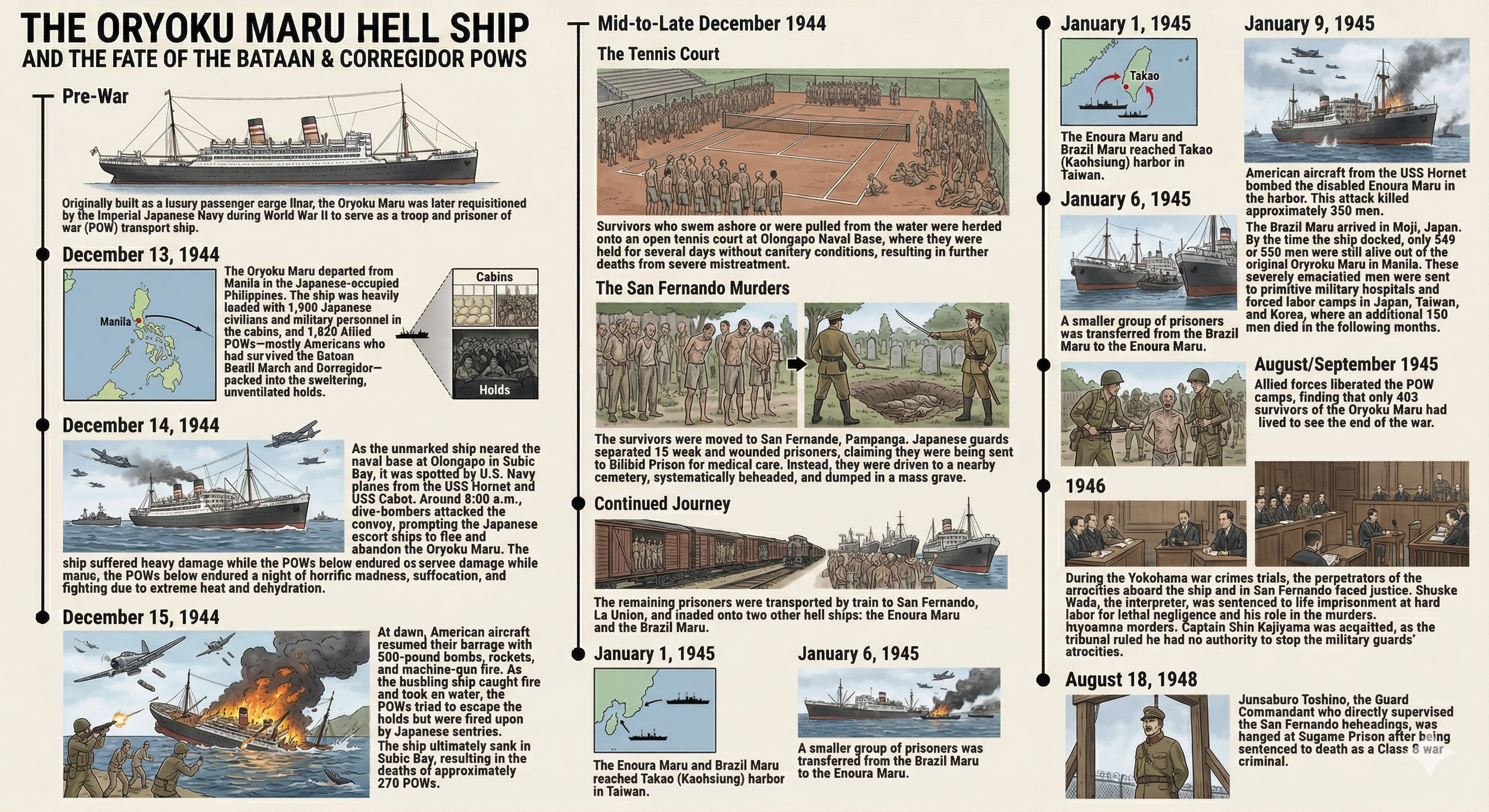
The Oryoku Maru Timeline
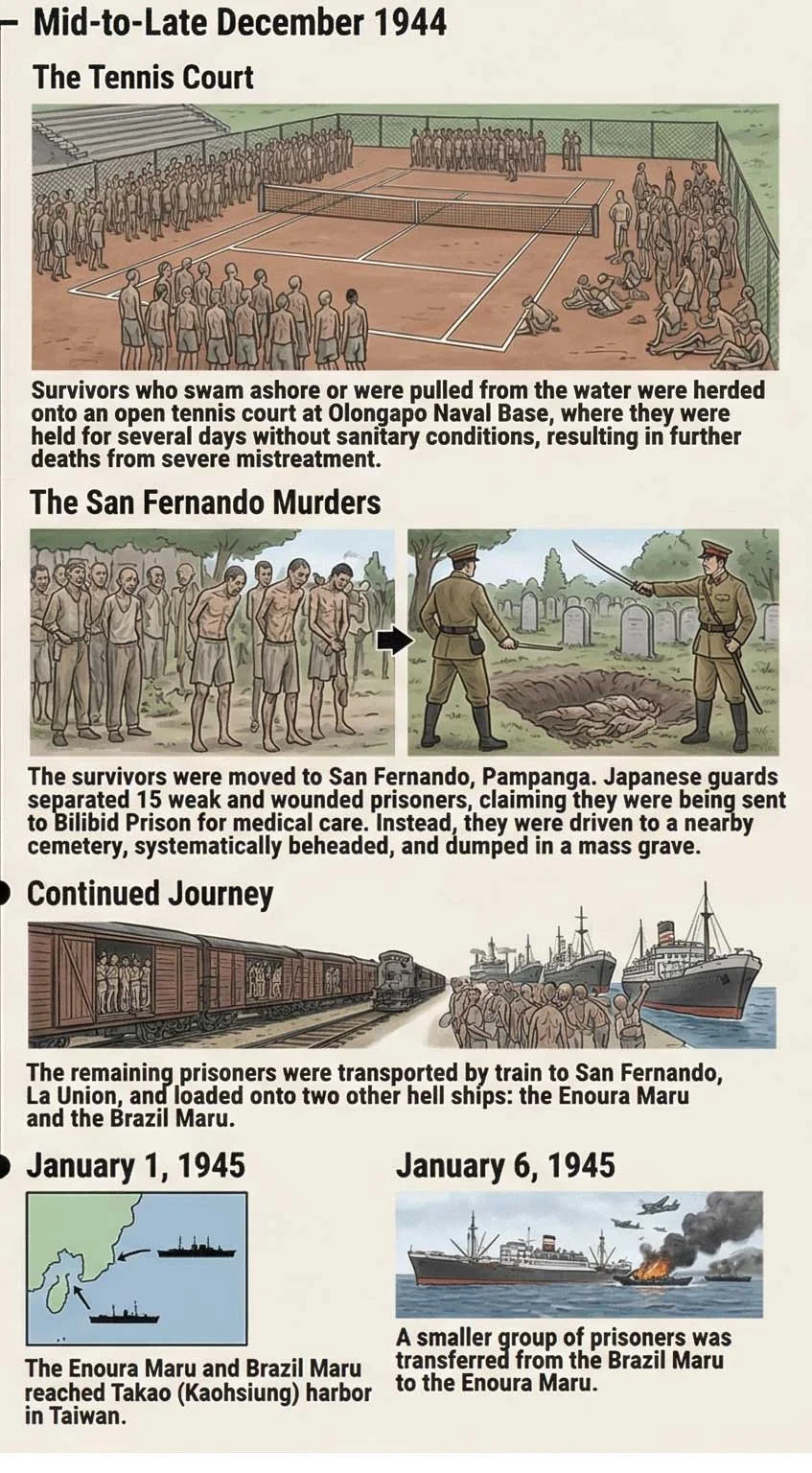
Sources
Naval History and Heritage Command, “The Japanese ‘Hell Ships’ of World War II”
U.S. National Archives, “American POWs on Japanese Ships Take a Voyage into Hell”
Pacific Wrecks, Oryoku Maru summary and voyage notes
BYU Religious Studies Center, “The Special Hell of the Oryoku Maru”
ABMC and DPAA updates relating to ongoing identification and commemoration work
Visit these pages for more information: