The Oryoku–Enoura–Brazil Maru Tragedy
One of the most brutal prisoner transport ordeals of the Pacific War, in which American POWs were carried from Manila through multiple Hellships before finally reaching Japan.
The Ships
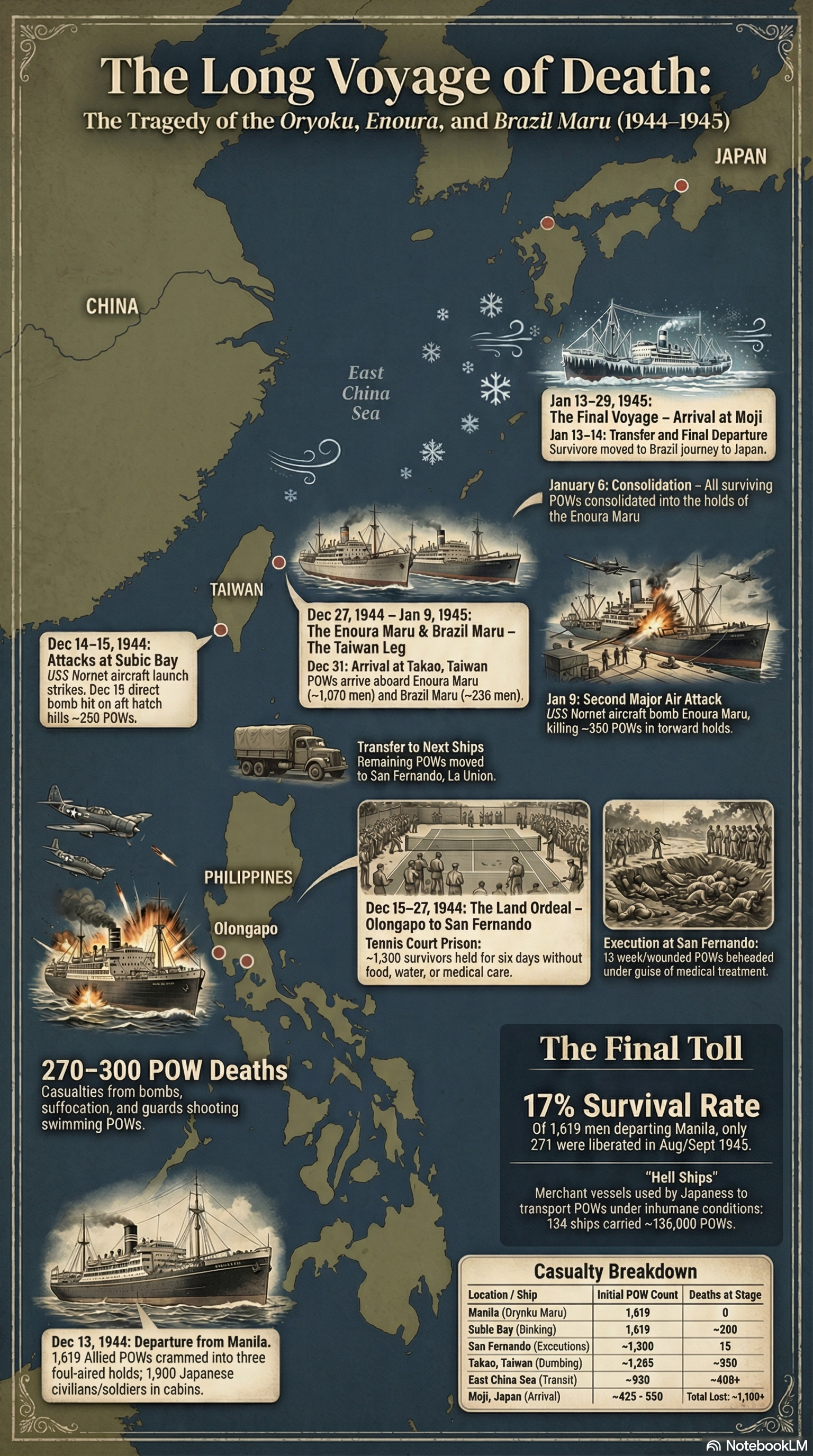
The Oryoku Maru, Enoura Maru, and Brazil Maru formed a sequence of Hellship transports that carried Allied prisoners of war from the Philippines to Japan during the final months of the war in 1944 and early 1945.
The prisoners involved were primarily American POWs captured during the fall of Bataan and Corregidor in 1942. After more than two years of imprisonment in camps across the Philippines, many were selected for transfer to Japan to work in mines, factories, and shipyards supporting the Japanese war effort.
Rather than being transported on a single ship, the prisoners were moved through a series of transports after each vessel was damaged or destroyed during Allied attacks. The result was a continuous ordeal across three separate Hellships.
The Voyage
The transport chain began in December 1944, when more than 1,600 American prisoners were loaded aboard Oryoku Maru in Manila.
The ship departed Manila Harbor on 13 December 1944 as part of a convoy bound for Japan. The prisoners were packed into the cargo holds with minimal ventilation, limited food and water, and almost no sanitation.
Within days of departure, the convoy encountered American aircraft operating in the South China Sea. Because the ship carried no markings identifying it as a POW transport, it was attacked as a legitimate military target.
After the loss of the first ship, survivors would be transferred to additional transports, extending the ordeal across multiple voyages.
The Attack
Oryoku Maru
On 14–15 December 1944, American carrier aircraft attacked the convoy near Subic Bay in the Philippines. Oryoku Maru was repeatedly bombed and eventually sank.
Many prisoners were killed in the attacks or drowned when the ship went down. Survivors struggled to escape from the cargo holds before the vessel sank.
Enoura Maru
Surviving prisoners were brought ashore and later loaded onto additional transports, including Enoura Maru.
The ship eventually reached Takao Harbor (modern Kaohsiung, Taiwan). While anchored there, American aircraft again attacked the harbor in January 1945. Bombs struck the ship and detonated within the holds, killing hundreds of prisoners.
Brazil Maru
The remaining survivors were transferred again, this time to Brazil Maru.
Brazil Maru completed the final leg of the voyage from Taiwan to Japan in January 1945, delivering exhausted survivors to labor camps where many would spend the remainder of the war.
Casualties and Survivors
The transport chain resulted in one of the highest death tolls among American POW transports during the war.
Many prisoners were killed during:
the bombing and sinking of Oryoku Maru
the air attack on Enoura Maru
the prolonged deprivation endured throughout the transport chain
Those who survived the journey arrived in Japan severely weakened after weeks of repeated transport, overcrowding, exposure, and starvation.
Despite the losses, hundreds of prisoners survived the ordeal and later testified to the conditions they endured aboard the Hellships.
Legacy and Memorialization
The Oryoku–Enoura–Brazil Maru transport chain is remembered as one of the defining examples of the Hellships system.
It illustrates several recurring elements of the Hellship experience:
POWs transported in unmarked cargo ships through combat zones
repeated transfers between ships after attacks
extreme overcrowding and deprivation in cargo holds
high casualty rates during transport
The story of these ships is closely connected to the broader history of American POWs from Bataan and Corregidor.
Today the transport chain is commemorated through memorials, historical research, and survivor accounts preserved in archives and museums dedicated to the history of the Pacific War.
Sources
U.S. National Archives – American POWs on Japanese Ships
American Defenders of Bataan and Corregidor (ADBC) historical records
Imperial War Museums POW transport research
Survivor testimony from Bataan and Corregidor prisoners
Related pages