Enoura Maru
A Second Hellship
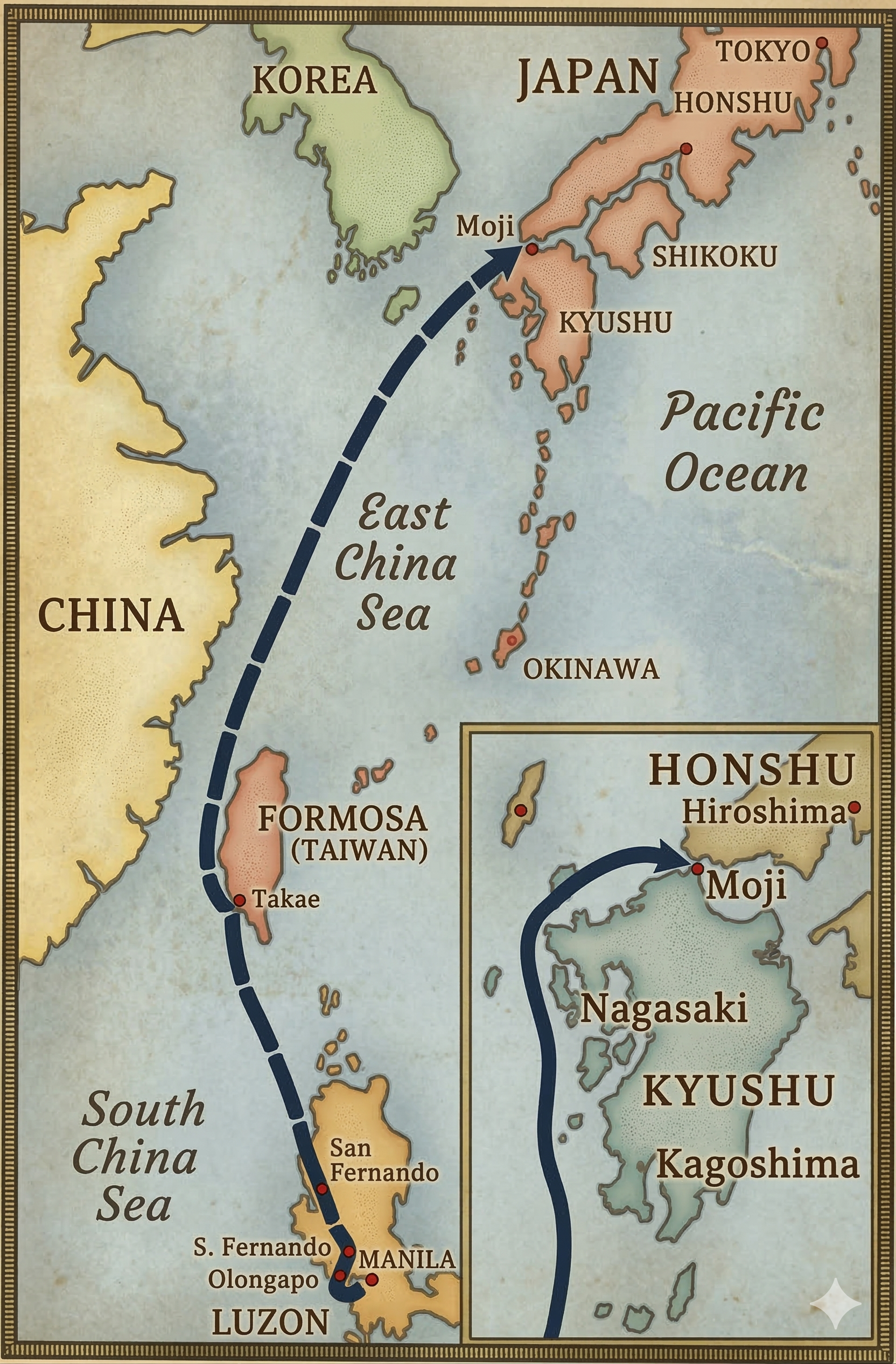
After surviving the destruction of Oryoku Maru near Subic Bay, the remaining American prisoners of war were gathered by Japanese guards and transported north through Luzon. Weak from starvation and exhaustion, the men were loaded onto trains and trucks and moved to another port.
Their destination was San Fernando, La Union, where another Japanese cargo vessel waited.
The ship was Enoura Maru.
For the prisoners, it meant returning once again to the suffocating darkness of a Hellship cargo hold.
Packed Below Deck
Hundreds of prisoners—many wounded or severely weakened—were forced into the cargo holds of Enoura Maru. Like the earlier transport, the ship was not designed to carry human passengers.
The prisoners were packed tightly together with almost no space to move. The holds quickly filled with heat, foul air, and the smell of sickness. Food and water were extremely limited.
The survivors of Oryoku Maru now faced another voyage under the same brutal conditions.
The ship departed the Philippines and began its journey north toward Formosa (modern Taiwan).
Arrival at Takao
After several days at sea the convoy reached Takao Harbor in Formosa in early January 1945. The prisoners hoped that the voyage might finally be over.
Instead, the ship remained anchored in the harbor with the prisoners still confined in the cargo holds.
Days passed with little food or water. Many prisoners were already suffering from disease, dehydration, and severe malnutrition.
Then, once again, the war intervened.
The Bombing of 9 January 1945
On 9 January 1945, American aircraft attacked Japanese shipping in Takao Harbor.
From the air, Enoura Maru appeared to be just another Japanese cargo vessel. The aircraft had no way of knowing that Allied prisoners of war were trapped inside the ship’s holds.
Bombs struck the vessel with devastating effect.
The explosions tore through the cargo holds where the prisoners were confined. Hundreds of men were killed instantly. Others were badly wounded as fragments of steel and wood ripped through the crowded compartments.
For the prisoners who survived the blast, the scene inside the hold was horrific.
Bodies lay piled together in the darkness. Many of the wounded received no medical care. Survivors later recalled the terrible suffering of the men trapped below deck after the attack.
After the Bombing
In the days that followed, the Japanese removed the surviving prisoners from the shattered ship. The wounded and the dead were carried out of the cargo holds and taken ashore.
The scale of the tragedy was enormous. Hundreds of prisoners of war had been killed during the bombing of Enoura Maru.
Yet even now the ordeal was not over for the survivors.
Those who remained alive were transferred to another transport ship waiting in the harbor.
That ship was Brazil Maru, which would carry them onward to Japan.
Mercer Endures
Sgt. William Mercer, having survived both the sinking of Oryoku Maru and the brutal voyage aboard Enoura Maru, found himself once again among the living when the survivors were assembled on the docks at Takao.
Around him stood men who had endured years of captivity and two Hellship voyages. Many were wounded, sick, or barely able to walk.
The prisoners were marched toward another vessel.
Mercer realized that the journey that had begun with the Bataan Death March was still not finished.
Continue the Journey