Montevideo Maru
In 1942, Montevideo Maru became the worst maritime disaster in Australian history.
The sinking of the Montevideo Maru resulted in a staggering loss of life. While exact tallies vary slightly due to the chaotic nature of the boarding, it is estimated that approximately 1,060 to 1,089 prisoners perished. The casualties included at least 850 Australian military personnel and over 200 civilians representing 14 different nationalities. Furthermore, 33 Norwegian sailors and 20 Japanese guards and crew died in the disaster.
The demographic of the victims was sweeping, ranging from a 15-year-old boy to men in their sixties. Entire groups were obliterated, including twenty members of a Salvation Army band embedded within the 2/22nd Battalion, and three inseparable brothers—Sidney, Dudley, and Daryl Turner—who had enlisted together in the 1st Independent Company. To contextualize the immense scale of this single incident, almost twice as many Australians died on the Montevideo Maru as were killed during the entire Vietnam War..
The Ship
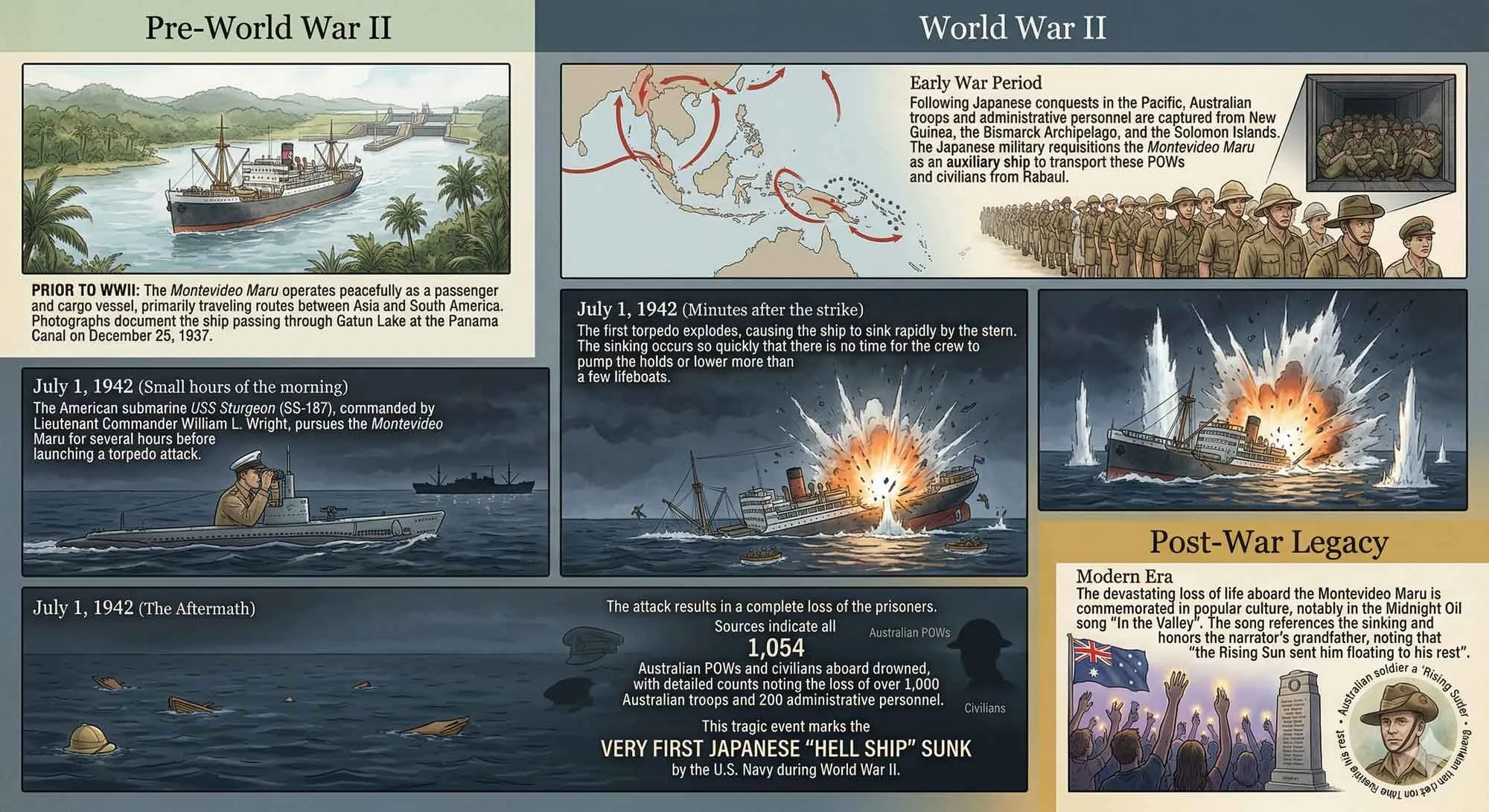
Originally built in Nagasaki, Japan, in 1926, the Montevideo Maru was a 7,266-ton, twin-screw diesel motor vessel. Before the outbreak of the Second World War, it operated as a passenger and cargo vessel for the Osaka Shosen Kaisha Shipping Line, primarily servicing routes between Japan and South America. Following the onset of the war, the Imperial Japanese Navy requisitioned the ship to serve as an auxiliary transport vessel. Assigned to the Kure Naval District, the ship participated in Japanese troop landings at Makassar in the Netherlands East Indies, and operated around the Japanese home islands and Java before being dispatched to New Britain.
Crucially, like many other Japanese Hellships, the Montevideo Maru operated as an unmarked cargo vessel. The Japanese military systematically utilized these ships to transport Allied POWs to Japan and other occupied territories to support wartime labor demands. Because they bore no insignia or markings indicating they were carrying prisoners of war, these heavily laden ships were entirely indistinguishable from legitimate military supply targets.
The Voyage
The backdrop to the fateful voyage was the Japanese invasion of Rabaul, New Britain, on January 23, 1942. The Australian garrison, known as Lark Force, was quickly overwhelmed, forcing troops to scatter into the jungle. Many surrendered and were held in prison camps, while civilians and administrative personnel were also interned.
On the morning of June 22, 1942, the Japanese authorities ordered members of the Australian 2/22nd Battalion, the 1st Independent Company, and numerous civilian internees to board the Montevideo Maru. Japanese guards meticulously divided the prisoners into groups of approximately fifty men for the march to the waterfront. Only a small number of civilians and military officers were left behind at the Malaguna Road camp. Laden with an estimated 845 POWs and roughly 209 civilian internees, the ship departed Rabaul. Unescorted, the vessel set a course for Hainan Island, where the prisoners were slated to be used as forced labor in the local mines. The ship's captain deliberately kept to the east of the Philippines in a futile attempt to avoid the growing threat of Allied submarines.
The Attack and Loss
Unbeknownst to the Japanese crew, the Allies had established sophisticated intelligence networks, such as the Joint Intelligence Center Pacific Ocean Area, which routinely intercepted Japanese radio transmissions tracking merchant ship movements. However, as these "Ultra" secret intercepts were passed down the chain of command, critical details regarding the presence of POWs were excised. Consequently, Allied submarine commanders operating in the Pacific were entirely unaware when they were targeting vessels packed with their own men.
Operating out of Fremantle, Australia, the U.S. Navy submarine USS Sturgeon, commanded by Lieutenant Commander W.L. Wright, was patrolling off the northwest coast of Luzon in the Philippines. On the night of June 30, 1942, the Sturgeon spotted the darkened Japanese freighter traveling westward at a high speed of at least 17 knots. Wright ordered his submarine to pursue the vessel at full power, struggling for an hour and a half to gain ground until the Montevideo Maru slowed to approximately 12 knots around midnight.
In the early hours of July 1, 1942, Wright manoeuvred the Sturgeon into an attack position, closing the range to 4,000 yards. At 02:25 am, the submarine fired a spread of four torpedoes from its stern tubes. At 02:29 am, an explosion rocked the Montevideo Maru roughly 100 feet aft of the funnel, striking an oil tank in the aft hold.
The ship suffered catastrophic damage, immediately taking on a steep angle. According to both the Sturgeon's patrol log and Japanese survivors, the vessel sank stern-first beneath the waves in just 11 minutes. The Japanese crew made no attempt to assist the trapped prisoners in abandoning the sinking ship. Only three lifeboats were successfully launched, which were entirely commandeered by the Japanese guards and crew. An estimated 100 POWs managed to escape the holds and clung to pieces of wooden wreckage in the dark waters. A Japanese eyewitness later recounted the heartbreaking scene of these doomed men singing Auld Lang Syne as a tribute to their dead colleagues before they too perished.
Casualties and Survivors
Public Australian sources consistently describe Montevideo Maru as Australia’s worst maritime disaster. The Australian War Memorial and the National Archives identify 1,054 Australians lost, including both military personnel and civilians. Searchable public summaries also note that very few Japanese aboard survived the sinking. The catastrophic death toll, the absence of Allied survivors from among the prisoners, and the long delay before families learned what had happened all contributed to the ship’s enduring place in Australian memory.
Legacy and Memorialization
The aftermath of the Montevideo Maru tragedy was characterized by a painful, protracted silence that deeply traumatized the victims' families. Back in Australia, the wives and mothers of the missing men endured immense psychological and financial hardship, with many civilian wives abandoned by their former employers and left without income.
The families were subjected to an agonizing puzzle of hope and despair. In April 1942, the Japanese had dropped letters from the prisoners during a bombing raid over Port Moresby, providing proof of life. However, after these letters, an official silence descended for nearly four years. When the war ended in September 1945, the devastating truth finally emerged following investigations in Tokyo. Despite the magnitude of the loss, the post-war Australian government refused to hold a formal inquiry into the fall of Rabaul, leaving widows and families without official answers and sparking decades of painful rumors. Because there were no witnesses, no physical remains, and no graves, the families were entirely denied the closure of visible mourning.
It was not until April 18, 2023—over 80 years later—that the wreck was finally discovered. An expedition organized by the Silentworld Foundation, in partnership with Dutch deep-sea survey company Fugro and the Australian Department of Defence, located the ship using an Autonomous Underwater Vehicle. The wreck rests at an extreme depth of more than 4,000 meters in the South China Sea, which is deeper than the Titanic. The site is officially recognized as a sacred war grave, and authorities have mandated that it will remain undisturbed, with no artifacts or human remains removed.
For many decades, the tragedy remained relatively unrecognized in the broader scope of World War II history. However, significant efforts have recently been made to honor the victims. In July 2012, a dedicated Rabaul and Montevideo Maru memorial was unveiled in the Sculpture Garden of the Australian War Memorial in Canberra. Designed by sculptor James Parrett, the 3.5-meter stainless steel abstract structure utilizes circular forms to symbolize physical and personal journeys, as well as the ocean, offering a timeless space for reflection.
More recently, following the discovery of the wreck, the Hellships Memorial Foundation has spearheaded a campaign to build a permanent "Montevideo Maru Monument of Remembrance". Designed to stand near the ocean in the Philippines, the preliminary concept includes a vertical stone or bronze monument aligned precisely toward the wreck site, complete with a compass marker, interpretive educational panels, and a gathering plaza. This proposed memorial aims to finally provide an international site for mourning, historical education, and reconciliation, ensuring that the thousands of lives sacrificed on the Hellships are never forgotten.
Sources
Australian War Memorial, “Montevideo Maru”
Australian War Memorial, “The sinking of the Montevideo Maru, 1 July 1942”
National Archives of Australia, “The sinking of the Montevideo Maru”
Australian Government Defence release, “Montevideo Maru found”
Australian War Memorial, press release on the wreck discovery
Related pages
The Monte Video Maru Tragedy
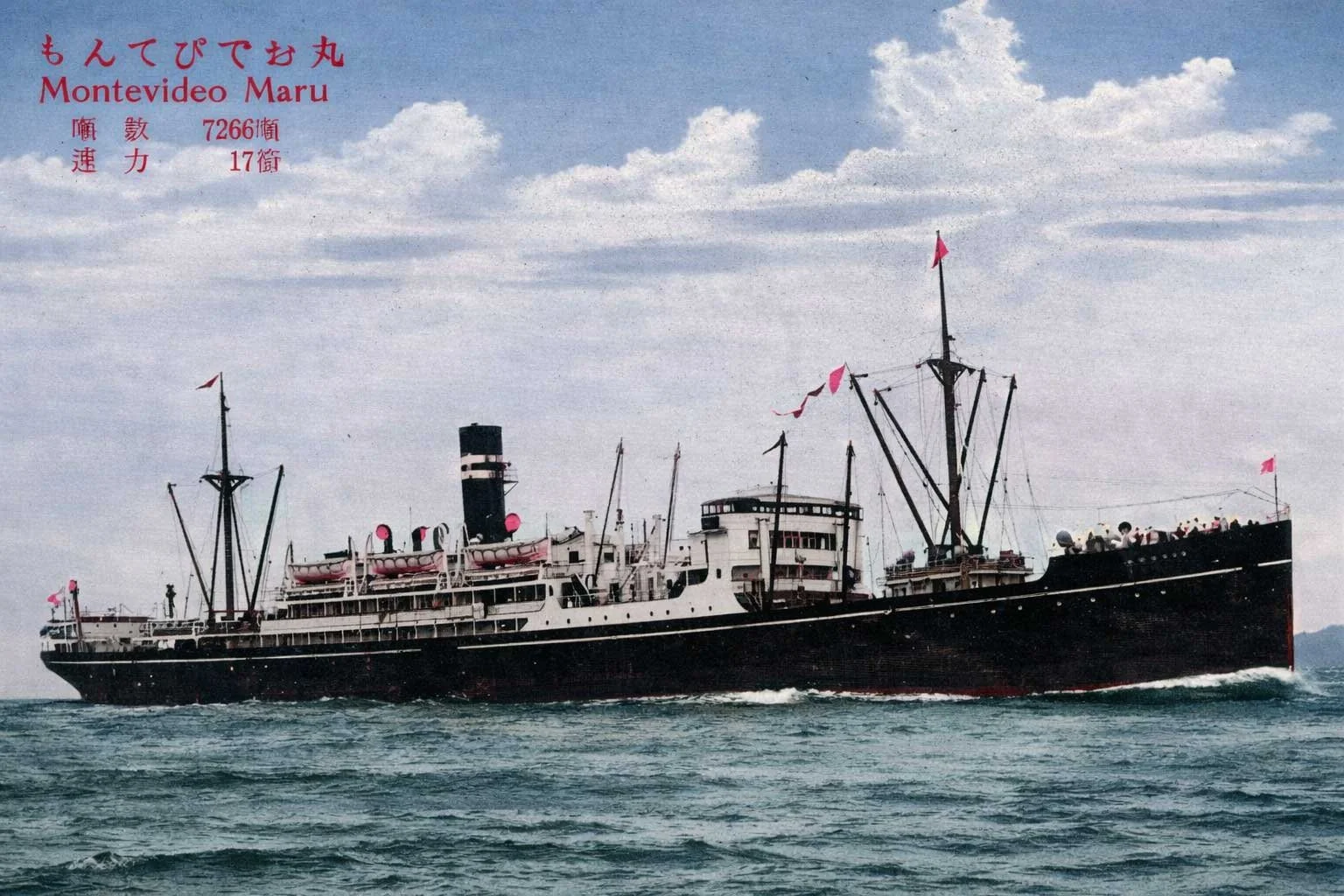
Technical Specifications
Vessel Type: Originally constructed as a passenger vessel and freighter, it was later requisitioned as an auxiliary transport vessel by the Imperial Japanese Navy.
Year Built: 1926.
Place of Construction: Nagasaki, Japan.
Pre-War Operator: Osaka Shosen Kaisha Shipping Line, which used the vessel for service between Japan and South America.
Tonnage: Approximately 7,266 to 7,267 tons.
Propulsion: Twin-screw diesel motor.