Rakuyō Maru
In 1944, Rakuyō Maru became one of the most tragic and widely remembered of the Japanese Hellships. A Japanese passenger-freighter used to transport Allied prisoners of war, it sailed from Singapore in early September 1944 carrying about 1,318 British and Australian POWs bound for Japan. On 12 September 1944, while part of convoy HI-72 in the South China Sea, it was torpedoed by the American submarine USS Sealion, whose crew had no way of knowing Allied POWs were aboard. Hundreds of prisoners survived the sinking only to drift for days on rafts or wreckage before rescue by American submarines or Japanese vessels. Rakuyō Maru is remembered both for its catastrophic loss of life and for the extraordinary submarine rescue of some of its survivors.
Key facts
Type: Passenger-cargo ship (later used as POW transport)
Built: 1921 by Mitsubishi Shipbuilding & Engineering Co., Nagasaki
Tonnage: About 7,300 gross tons
Sunk: September 12, 1944, South China Sea
Casualties: Roughly 1,050 POWs killed
The Ship
Rakuyō Maru was a Japanese passenger-freighter later used in wartime convoy service. By 1944, it had been assigned to transport British and Australian prisoners of war from Southeast Asia toward Japan, where many were intended for forced labor. Like other Hellships, the vessel was not marked to indicate that it carried POWs, even though it was moving through waters heavily hunted by Allied submarines. In postwar memory, Rakuyō Maru became one of the most important symbols of the danger and cruelty of the Japanese POW transport system.
The Final Voyage
By late 1944, the Japanese war machine was suffering from severe labor shortages, prompting the mass relocation of captive manpower from Southeast Asia to the factories and mines of Formosa (Taiwan) and the Japanese home islands [265, conversation history]. In September 1944, Rakuyō Maru was docked in Singapore, where it was loaded with a human cargo of 1,317 Australian and British prisoners of war.
Rakuyō Maru departed Singapore bound for Formosa, sailing as part of a heavily guarded convoy. This convoy also included another infamous hell ship, the 10,509-ton Kachidoki Maru, which was carrying approximately 950 British POWs. As the convoy steamed north through the Pacific, the 1,317 men aboard Rakuyō Maru endured the standard, abysmal conditions characteristic of the hell ship experience. Packed tightly into the lower decks, the men suffered from hyperthermia, asphyxia, and disease. Compounding their extreme physical suffering was a fatal tactical reality: the Japanese military refused to mark ships carrying POWs with red crosses or any other identifiers that would signify the presence of non-combatants. Because Rakuyō Maru was unmarked and traveling within a military convoy, it was a fully legitimate target under the rules of unrestricted submarine warfare.
The Final Attack
As the Japanese convoy navigated the South China Sea, it was unwittingly sailing into a deadly trap. The convoy's movements were being tracked by highly classified Allied "Ultra" intelligence [conversation history]. However, the Pacific submarine campaign operated under a tragic paradox. While decrypted Japanese codes provided the exact locations and headings of enemy convoys, any details regarding the presence of POWs were deliberately excised from the operational briefings passed down to submarine commanders. This intelligence filtering was done to protect the closely guarded secret that the Japanese military codes had been broken [conversation history]. Consequently, the American submarine crews patrolling the area had absolutely no knowledge that thousands of their own allies were trapped in the hulls of the approaching ships.
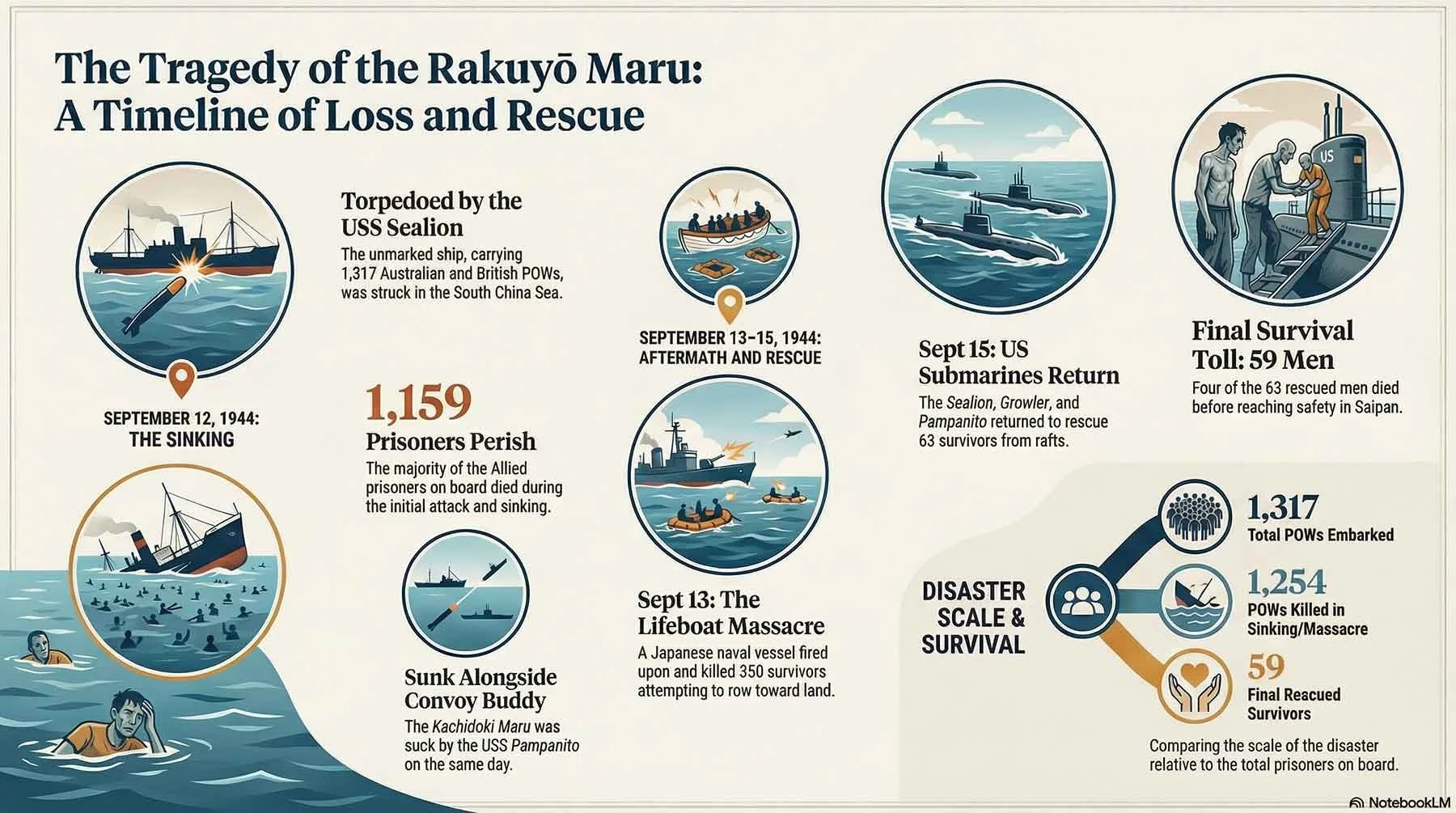
On September 12, 1944, a wolfpack of United States Navy submarines intercepted the Japanese convoy [265, 278, conversation history]. During the coordinated assault, USS Sealion acquired Rakuyō Maru as a target. The American submarine fired a spread of torpedoes that struck the unmarked 9,419-ton transport at coordinates 18°42'N, 114°30'E. At the exact same time, another submarine in the wolfpack, USS Pampanito, successfully torpedoed the convoy mate Kachidoki Maru. The torpedo strikes on Rakuyō Maru caused catastrophic structural damage, triggering a rapid sinking. The explosions instantly killed many of the prisoners trapped in the unventilated holds, while hundreds of other desperate survivors fought their way up the steep ladders to abandon the sinking ship, throwing themselves into the chaotic, debris-filled ocean
Casualties and Survivors
The human toll of the sinking of Rakuyō Maru was staggering. Out of the 1,317 Australian and British POWs aboard, a total of 1,159 men perished. However, these deaths were not solely the result of the torpedo explosions or drowning. The tragedy was compounded by an act of deliberate, premeditated murder committed by the Japanese military.
Following the sinking of Rakuyō Maru, approximately 350 POWs miraculously survived the initial disaster and managed to pull themselves into floating lifeboats. Under international law, specifically the Hague Convention of 1907, the killing of shipwreck survivors is strictly prohibited under any circumstances. Despite this, the Japanese naval escorts demonstrated a chilling disregard for human life and the rules of war. The day after the sinking, as the 350 desperate Allied survivors were rowing their lifeboats toward land, they were intercepted by a Japanese navy vessel. Rather than rescue or ignore the helpless men, the Japanese vessel actively bombarded the lifeboats, slaughtering all 350 prisoners of war. This cold-blooded massacre ensured that the vast majority of those who escaped the sinking hull were violently executed on the open water.
Despite the torpedoes, the drowning, and the Japanese massacre, the story of Rakuyō Maru ended with one of the most remarkable rescue operations of the Pacific War. A small number of POWs had managed to evade the Japanese naval vessels and remained adrift in the ocean, clinging to makeshift rafts and wreckage. For three agonizing days, they floated under the blazing tropical sun without food or water.
On September 15, the very American submarines that had decimated the convoy—the USS Sealion, USS Growler, and USS Pampanito—returned to the battle area. While navigating the debris field, the submarine crews were shocked to discover Allied survivors in the water. The submarines immediately initiated a rescue operation, pulling 63 surviving POWs from their rafts and bringing them aboard. The men were in critical condition from severe exposure, starvation, and untreated wounds. Despite the medical efforts of the submarine crews, four of the rescued men died at sea before the submarines could deliver them to safety at Tanapag Harbor in Saipan, in the Mariana Islands.
Legacy and Memorialization
The destruction of Rakuyō Maru remains one of the darkest and most complex episodes in the history of the hell ships. The staggering loss of 1,159 lives serves as a grim testament to the horrific expendability of prisoners of war within the Japanese imperial logistics system, which viewed captive men merely as cargo to be exploited. Furthermore, the sinking perfectly encapsulates the profound moral tragedy of the Allied submarine campaign. The necessary tactical destruction of the Japanese merchant fleet resulted in the unintentional, yet devastating, slaughter of thousands of captive Allied servicemen.
Today, the legacy of Rakuyō Maru is preserved in solemn remembrance by historians, military organizations, and the descendants of the victims. The men who perished on September 12, 1944, are honored alongside the more than 20,000 Allied POWs who died at sea. Their deaths stand as a permanent reminder of the absolute vulnerability of prisoners of war, who miraculously survived the brutalities of the battlefield and the squalor of prison camps, only to perish in the dark holds of unmarked ships targeted by their allies, or to be mercilessly murdered in the water by their captors.
Sources
Australian War Memorial, Second World War – Prisoners of the Japanese, Prison ships (Rakuyō Maru archival guide)
USS Pampanito, The Third War Patrol and POW rescue account
POW Research Network Japan, Rakuyō Maru
Imperial War Museums, The Sinking of Prisoner of War Transport Ships in East Asia
Australian War Memorial image record of Rakuyō Maru survivors
Related pages