Rakuyō Maru and Kachidoki Maru (1944)
Two British POW transports lost in the same convoy disaster in the South China Sea, remembered for both catastrophic loss and one of the most remarkable submarine rescues of the Second World War.
The Ships
Rakuyō Maru and Kachidoki Maru were Japanese cargo ships used to transport Allied prisoners of war during the later stages of the Pacific War. In September 1944 both ships were part of a convoy carrying British and Commonwealth prisoners from Southeast Asia toward Japan.
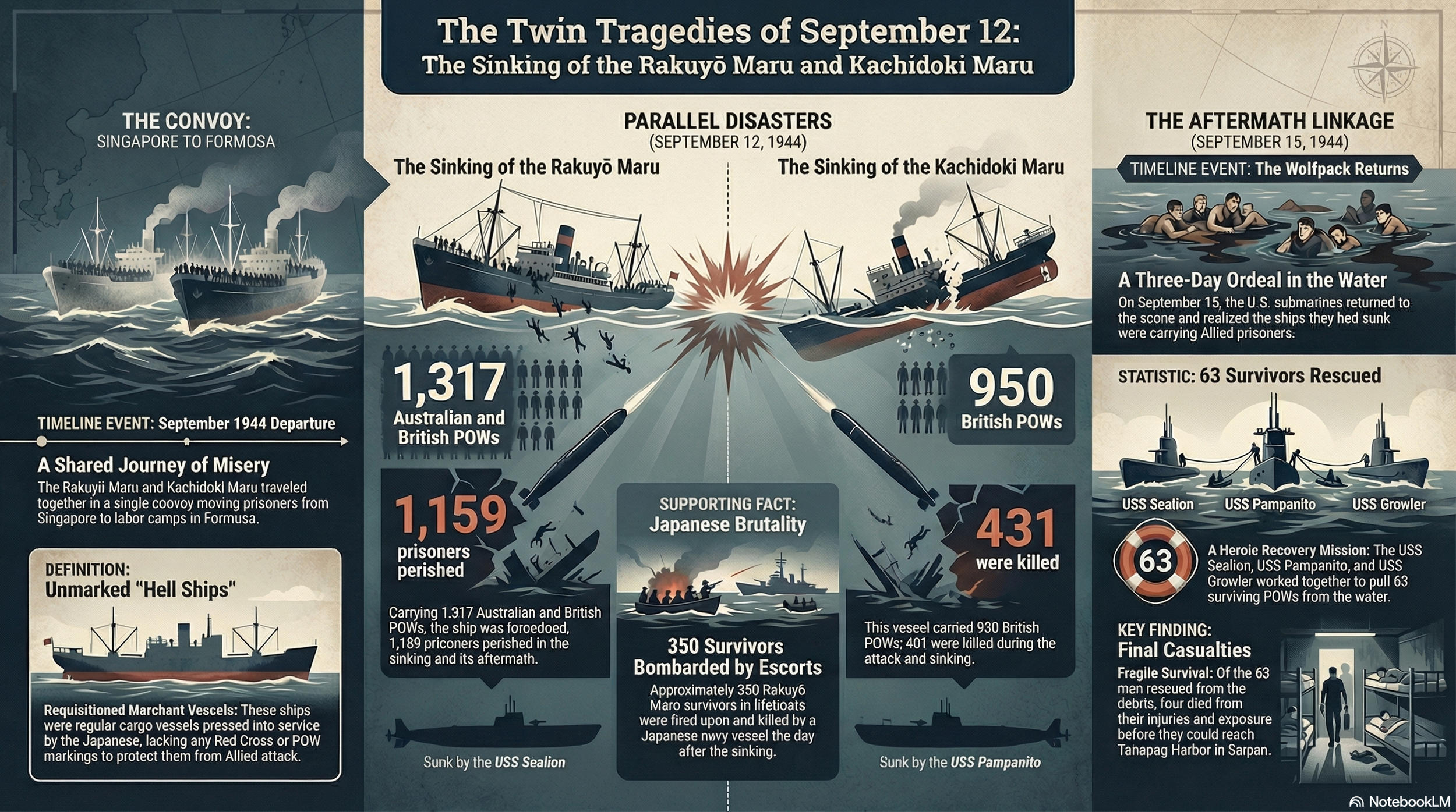
Rakuyō Maru carried approximately 1,300 British POWs, many captured in Singapore and other Southeast Asian campaigns. Kachidoki Maru carried an even larger group of prisoners, including British soldiers, merchant seamen, and other Allied personnel.
Both ships formed part of a large convoy traveling north from Singapore. Like many POW transports of the period, they were unmarked and indistinguishable from ordinary Japanese military shipping, making them legitimate targets for Allied submarines operating in the South China Sea.
The Voyage
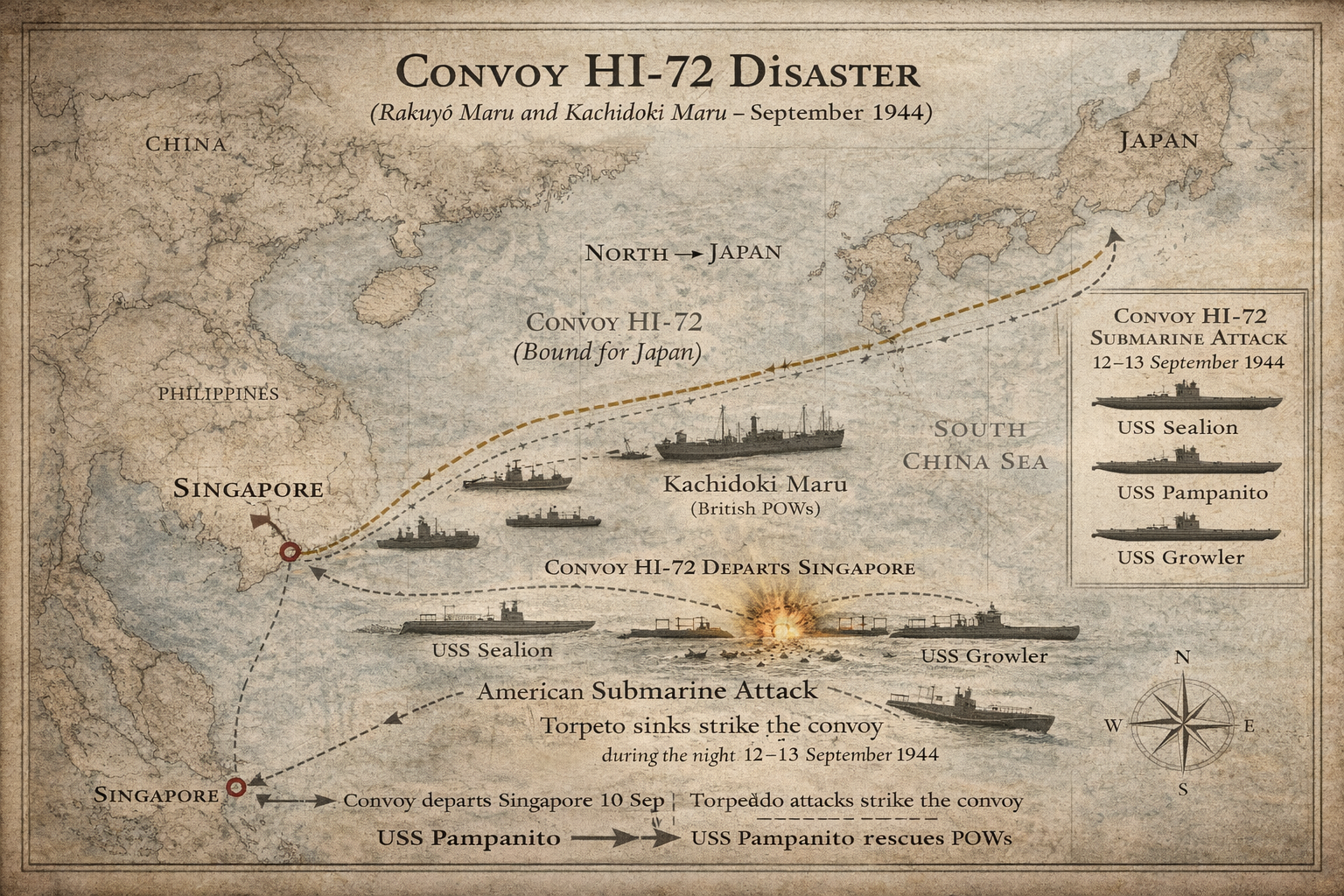
The ships departed Singapore in September 1944 as part of Convoy HI-72, bound for Japan. The convoy included numerous cargo vessels, troop transports, and escorting warships. Its route carried it through the South China Sea, an area increasingly dangerous for Japanese shipping due to American submarine patrols.
Conditions aboard both ships were typical of the Hellships. Prisoners were confined in overcrowded cargo holds with little ventilation, minimal food and water, and almost no sanitation. The voyage north was expected to deliver the prisoners to labor camps in Japan, where many POWs were assigned to mines, factories, and docks supporting the Japanese war effort.
The Attack or Loss
During the night of 12–13 September 1944, American submarines operating in the South China Sea intercepted the convoy.
Submarines involved in the attack included:
USS Sealion
USS Pampanito
USS Growler
These submarines launched torpedo attacks against the convoy’s transport ships. Because the vessels carried no markings identifying them as POW transports, they were attacked as ordinary Japanese military targets.
Both Rakuyō Maru and Kachidoki Maru were torpedoed during the attack.
Rakuyō Maru was struck and later sank in the early hours of 13 September. Kachidoki Maru was also hit and went down during the same convoy disaster. Prisoners trapped in the holds struggled to escape as the ships sank, and many were unable to reach the deck before the vessels went under.
The sinking of the two ships formed one of the largest POW maritime disasters of the Pacific War.
Casualties and Survivors
The losses from the convoy disaster were devastating.
On Rakuyō Maru, hundreds of British prisoners were killed when the ship sank. Many others survived the sinking and remained in the water for extended periods.
On Kachidoki Maru, even greater numbers of prisoners perished.
One of the most remarkable episodes of the disaster occurred when the submarine USS Pampanito surfaced and rescued survivors from the sea. Pampanito’s crew brought dozens of POWs aboard the submarine, providing medical treatment, food, and protection before transferring them later to Allied authorities.
The Pampanito rescue became one of the few instances in the Pacific War where a submarine directly rescued survivors of a POW transport sinking.
Despite these rescues, the combined losses from Rakuyō Maru and Kachidoki Maru were among the largest POW maritime tragedies of the war.
Legacy and Memorialization
The loss of Rakuyō Maru and Kachidoki Maru is remembered as one of the defining Hellship disasters involving British and Commonwealth prisoners.
The event illustrates several key aspects of Hellship history:
POWs transported in unmarked ships through combat zones
catastrophic losses during submarine attacks
the continued ordeal of survivors after sinking
rare but significant rescue efforts by Allied forces
Today the disaster is commemorated in multiple national memorials and historical records honoring those who perished.
The story of the convoy is also closely associated with the history of USS Pampanito, whose rescue of survivors remains one of the most extraordinary humanitarian actions by a submarine during the war.
Sources
U.S. National Archives – American POWs on Japanese Ships
Imperial War Museums – Prisoner of War Transport Ships in East Asia
POW Research Network Japan – Hellship transport records
Survivor testimonies and convoy research related to Convoy HI-72
Related pages