Kachidoki Maru
In 1944, Kachidoki Maru became one of the major Hellship disasters of the war when it was sunk in the South China Sea while carrying about 900 British prisoners of war from Singapore toward Japan. The ship sailed as part of convoy HI-72, alongside Rakuyō Maru, in early September 1944. On 12 September 1944, American submarines attacked the convoy, and Kachidoki Maru was torpedoed and sunk. Because the ship was unmarked, the attackers had no way of knowing Allied POWs were aboard. Although many prisoners were later rescued by Japanese escort vessels and taken on to Japan, hundreds died in the sinking and immediate aftermath, making Kachidoki Maru one of the most significant British POW transport tragedies of the Pacific War.
The Ship
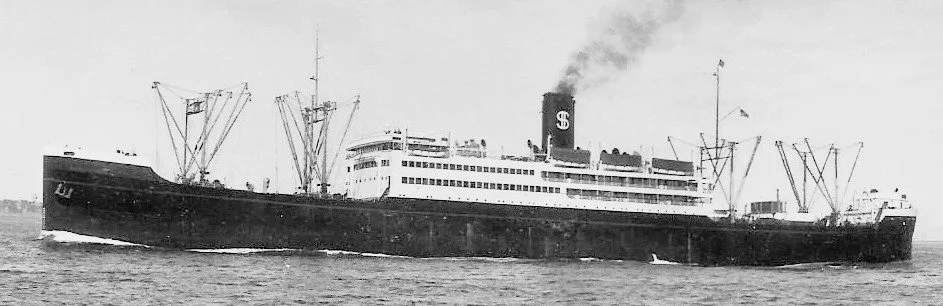
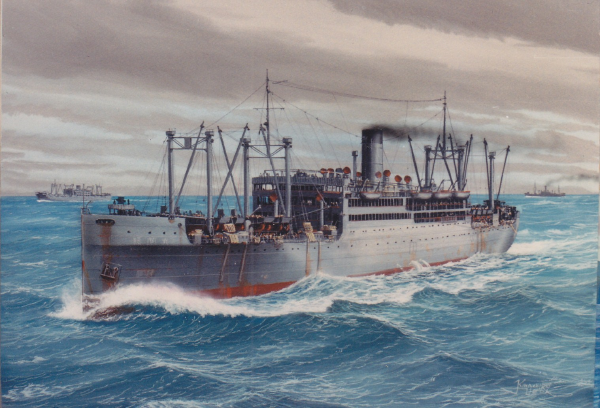
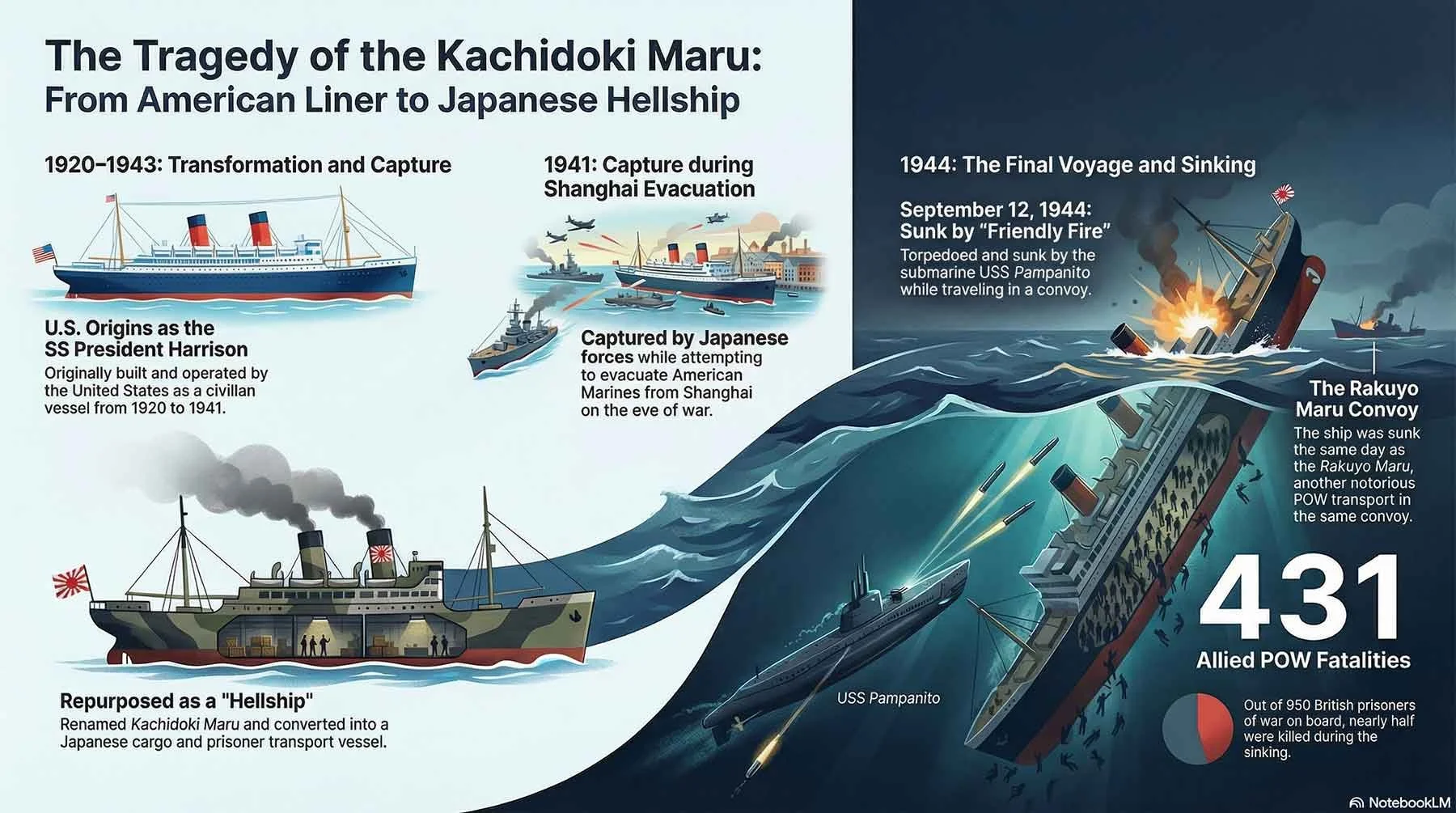
Kachidoki Maru was the former American liner President Harrison, captured by Japan and later renamed for wartime service. By 1944 it was being used as a transport in Japan’s military shipping system, including the movement of Allied POWs. Like other Hellships, it carried prisoners without any markings to identify their protected status, even while operating through waters heavily threatened by Allied submarines. This made it part of the same dangerous POW transport system that doomed so many unmarked ships late in the war.
The Final Voyage
As the convoy steamed north through the South China Sea, it was unknowingly being tracked by Allied intelligence. A devastating paradox of the Pacific submarine campaign was the highly classified "Ultra" intelligence program; while decrypted Japanese codes gave Allied forces the exact locations of enemy convoys, details regarding the presence of POWs were deliberately excised from operational briefings to protect the secret that the codes had been broken [conversation history]. Consequently, American submarine commanders peering through their periscopes had no idea that thousands of their own allies were trapped inside the targeted hulls.
The fatal blow to the convoy arrived on September 12, 1944. A wolfpack of United States Navy submarines intercepted the Japanese ships. During the coordinated assault, USS Sealion (SS-315) successfully targeted and torpedoed the Rakuyo Maru. Simultaneously, the submarine USS Pampanito (SS-383) set its sights on Kachidoki Maru.
USS Pampanito fired a spread of torpedoes that struck Kachidoki Maru with devastating precision at coordinates 19°18'N, 111°53'E. The explosions crippled the large 10,509-ton transport, tearing through the hull and instantly killing many of the prisoners trapped in the lower decks. As the former American liner began to rapidly take on water and sink into the depths, the surviving British POWs scrambled desperately up the ladders to abandon ship, throwing themselves into the churning, debris-filled ocean.
The Fatal Attack
The sinking of Kachidoki Maru resulted in a catastrophic loss of life, compounding the misery the men had already endured in the squalor of the holds. Out of the roughly 900 to 950 British prisoners of war aboard, between 400 and 431 men perished. Many were killed instantly by the torpedo blasts, while others, weakened by disease and starvation, drowned before they could escape the sinking hull or succumbed to exhaustion in the open water.
For the men who managed to survive the sinking, their ordeal in the sea was harrowing. Unlike several other hell ship disasters where Japanese escorts actively machine-gunned survivors in the water—such as the massacres following the sinkings of Suez Maru and Shinyo Maru—the Japanese naval vessels accompanying this convoy did eventually mount a rescue operation for a portion of Kachidoki Maru survivors. Japanese ships pulled roughly 500 surviving British POWs from the water.
However, this rescue did not mean liberation. The Japanese authorities remained entirely indifferent to the trauma the prisoners had just suffered and refused to deviate from their operational mandate. The rescued men were immediately transferred to another transport vessel, Kibitsu Maru, and were forced to continue their agonizing journey to Japan to be utilized as slave labor.
In a contrasting twist of fate, the survivors of Kachidoki Maru's convoy mate, Rakuyo Maru, were initially abandoned by the Japanese. Three days later, on September 15, USS Pampanito—the very submarine that had sunk the Kachidoki Maru—along with the USS Sealion and USS Growler, returned to the battle area and miraculously discovered 63 Allied POWs clinging to makeshift rafts. While Rakuyo Maru survivors were brought to safety by the American submarines, the surviving men of Kachidoki Maru remained in the iron grip of their captors until the end of the war.
Casualties and Survivors
The casualty and survivor totals for Kachidoki Maru differ somewhat across sources, but the broad picture is clear. USS Pampanito patrol history states that of the 900 POWs aboard, 656 were rescued by the Japanese and taken on to prison camps in Japan, implying the loss of about 244 POWs. By contrast, CombinedFleet records that escorts rescued 521 POWs and notes 476 passengers killed, a figure that includes POWs but is not limited to them. POW Research Network Japan similarly records a substantial loss of life in the sinking. Because these totals vary depending on whether they count only POWs or all passengers, the page should state openly that Kachidoki Maru suffered hundreds of POW deaths, while a large number of survivors were nevertheless recovered by Japanese vessels and transported onward to Japan.
Legacy and Memorialization
The destruction of Kachidoki Maru stands as one of the most poignant and tragic episodes of the Pacific War's hell ship history. The massive death toll is a grim testament to the horrific expendability of prisoners of war within the Japanese imperial war machine, which viewed captive men merely as commodities to be exploited. Furthermore, the sinking encapsulates the profound moral tragedy of the Allied submarine campaign; the necessary tactical destruction of the Japanese merchant fleet resulted in the unintentional slaughter of thousands of captive Allied servicemen.
Kachidoki Maru is particularly symbolic of the chaotic and tragic nature of the Pacific War. A vessel originally christened SS President Harrison and designed by Americans to transport and rescue American troops, it was twisted by war into a Japanese floating dungeon, only to be ultimately destroyed by an American submarine.
Today, the legacy of Kachidoki Maru and the roughly 400 British soldiers who perished in its holds is preserved in solemn remembrance. Their sacrifice—alongside the 20,000 other Allied POWs who died at sea—is honored by historians, veterans' associations, and descendants who strive to ensure the horrors of the hell ships are never forgotten. The men lost on September 12, 1944, serve as a permanent reminder of the immense and often unquantifiable human cost of World War II, where brave men survived the brutalities of the battlefield and the squalor of prison camps, only to perish tragically in the dark holds of unmarked ships targeted by the very forces fighting to liberate them.
Sources
POW Research Network Japan, Kachidoki Maru
USS Pampanito, The Third War Patrol
CombinedFleet, KACHIDOKI MARU Tabular Record of Movement
Imperial War Museums, The Sinking of Prisoner of War Transport Ships in East Asia
Australian War Memorial, 70th anniversary of the sinking of the Rakuyō Maru and Kachidoki Maru
Related pages