Jun’yō Maru
In 1944, Jun’yō Maru became one of the deadliest maritime disasters of the Second World War. A Japanese cargo ship used to transport Allied prisoners of war and thousands of Asian forced laborers, it sailed from Batavia, Java, in September 1944, bound for Sumatra. On 18 September 1944, off the west coast of Sumatra, the unmarked ship was torpedoed by the British submarine HMS Tradewind, whose crew had no way of knowing that POWs and romusha were aboard. Public historical accounts agree that the sinking killed more than 5,000 people, making Jun’yō Maru one of the largest Hellship tragedies of the war.
Key facts
Type: Cargo steamship / Japanese hell ship
Built: 1913, Robert Duncan & Co., Port Glasgow, Scotland
Tonnage & size: ~5,000 gross tons, about 400–405 ft (≈123 m) long
Sunk: September 18, 1944, by HMS Tradewind near western Sumatra
Estimated deaths: Over 5,000; many estimates around 5,500–5,600
The Ship
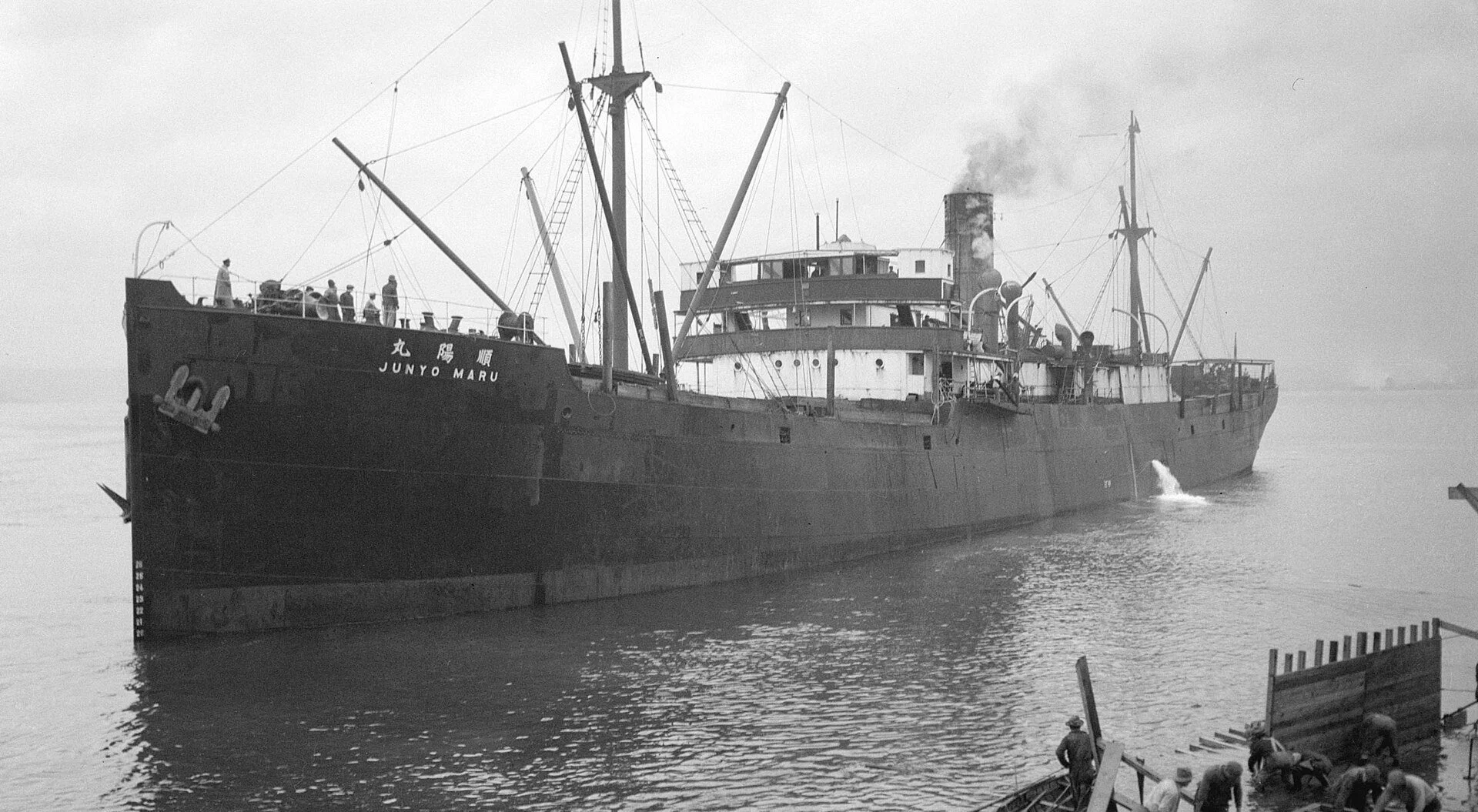
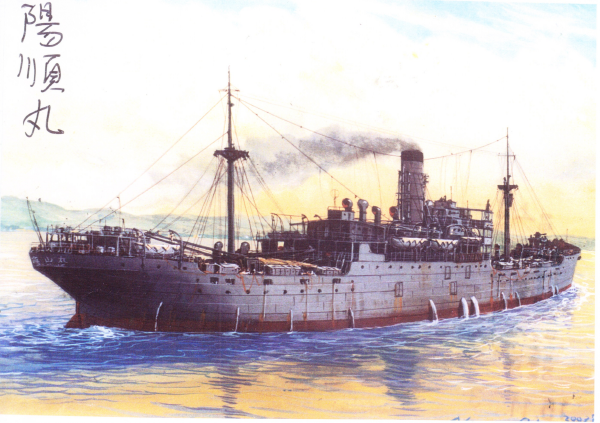
Jun’yō Maru was a Japanese cargo vessel pressed into wartime transport service. By 1944 it was being used within Japan’s wider labor and prisoner transport system, moving Allied POWs and Asian civilian forced laborers to work sites in occupied territory. Like other Hellships, it was not marked to identify the presence of prisoners on board, even though it was sailing through waters patrolled by Allied submarines. The ship is now remembered not only as a POW transport, but as a vessel whose loss also claimed the lives of thousands of romusha.
The Voyage
According to the POW Research Network Japan, Jun’yō Maru left Batavia harbor on 16 September 1944, briefly anchored nearby, and then continued westward carrying large numbers of prisoners and laborers toward Sumatra. Public historical summaries consistently describe the human cargo as including Allied POWs from camps in Java together with several thousand romusha, Asian forced laborers recruited or compelled into Japanese wartime service. This mixed human cargo is one reason Jun’yō Maru occupies such an important place in Hellship history: it was not only a POW tragedy, but also a mass-casualty labor transport disaster.
The Attack
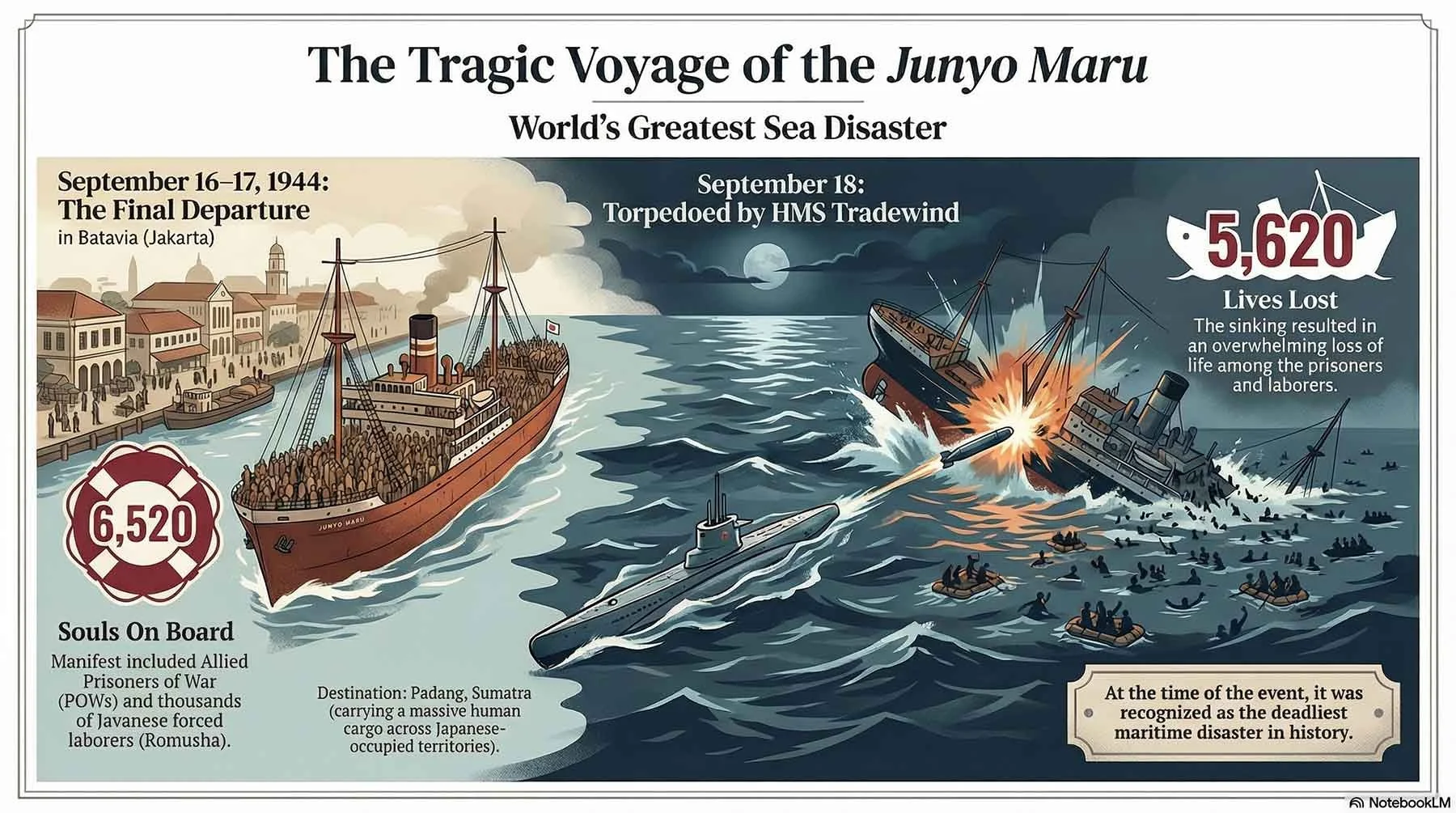
The doomed voyage of the Jun'yō Maru lasted only two days. The Jun'yō Maru departed from Tandjoeng Priok, the port of Batavia (modern-day Jakarta), on September 16, 1944. As the overloaded freighter steamed into the open ocean, the 6,500 men aboard were subjected to the universally abhorrent conditions that defined the hell ship experience.
Prisoners on these voyages were routinely crammed into cargo bays so tightly that there was scarcely room to sit or lie down. They were denied adequate air, ventilation, food, and water. In the sweltering tropical climate, the holds quickly became incubators for terminal dehydration, hyperthermia, and diseases like dysentery. Men frequently went mad in the darkness from the heat and lack of oxygen.
As the Jun'yō Maru navigated the waters off the Dutch East Indies, it was unknowingly sailing directly into a tightening Allied blockade. By the fall of 1944, American, British, and Dutch submarines were actively prowling the Pacific and Indian Oceans, operating under unrestricted warfare protocols that authorized them to sink any Japanese merchant vessel supporting the empire's logistics. Because the Japanese military refused to mark ships carrying POWs as non-combatant vessels, Allied submarine commanders peering through their periscopes had no way of knowing that ships like the Jun'yō Maru were packed with thousands of their own allies. Even highly classified Allied intelligence intercepts, which often tracked the movements of Japanese shipping convoys, routinely excised any specific information regarding the presence of POWs before the intelligence was passed down to the submarine commanders on the firing line.
The HMS Tradewind fired its torpedoes, striking Jun'yō Maru with devastating precision. The vessel was hit by two torpedoes—one slamming into the bow and the other detonating near the stern. The structural damage to the 5,065-ton ship was catastrophic and immediate.
For the 6,500 POWs and rōmusha trapped in the darkened holds, the dual explosions heralded a nightmare. The sinking of Jun'yō Maru was incredibly rapid; the vessel plummeted beneath the surface of the ocean in just 20 minutes. Because the holds were massively overcrowded and the ship sank so quickly, the vast majority of the captives had absolutely no chance to climb the steep ladders, escape the cargo bays, and abandon the ship.
The resulting death toll made the sinking of Jun'yō Maru one of the deadliest maritime disasters in world history. Out of the approximately 6,500 men aboard, an estimated 5,626 perished. The loss of life among the Asian slave laborers was nearly total, with approximately 4,000 rōmusha drowning or dying in the explosions. The Dutch and Allied POWs suffered similarly devastating casualties, losing 1,626 men to the sea.
Miraculously, a small fraction of the men managed to survive the initial torpedo strikes and the rapid sinking of the hull. Japanese ships operating in the vicinity arrived at the wreckage and managed to pull several hundred men from the water. In total, approximately 200 rōmusha and 674 Allied POWs were rescued by their captors.
However, for these 874 survivors, their deliverance from the ocean did not mean an end to their suffering. Unmoved by the horrific trauma the men had just endured, the Japanese military authorities did not deviate from their original operational plans. The rescued POWs and rōmusha were transported directly to their intended destination and incarcerated in a prison in Padang, Sumatra. There, they were forced into the very slave labor operations on the Sumatra Railway that Jun'yō Maru had been sent to supply. The physical and psychological toll of the sinking continued to claim lives even on dry land, with records indicating that at least eight more prisoners died shortly after arriving at the Padang prison.
Casualties and Survivors
Publicly available totals vary somewhat depending on whether the figures emphasize Allied POWs, romusha, or the combined total. The broad historical picture, however, is clear: more than 5,000 people died in the sinking, making Jun’yō Maru one of the deadliest Hellship losses of the war. The dead included large numbers of Allied POWs as well as thousands of romusha, while only a fraction of those on board survived. Because different sources count these groups differently, any database or memorial page should make clear whether a number refers to total deaths, POW deaths only, or combined POW-and-romusha losses.
Legacy and Memorialization
The sinking of the Jun'yō Maru remains a profoundly tragic encapsulation of the hell ship history. It stands as a stark testament to the sheer scale of the Japanese forced labor system, highlighting the horrific expendability of both Western prisoners and Asian civilians within the imperial war machine. Furthermore, the disaster represents the agonizing moral paradox of the Pacific War's submarine campaign, where the necessary tactical destruction of the Japanese merchant fleet resulted in the unintentional, yet devastating, slaughter of thousands of captive Allied lives.
Sources
Imperial War Museums, “The Sinking of Prisoner of War Transport Ships in East Asia”
POW Research Network Japan, Junyo Maru
Commonwealth War Graves Commission, Corporal Jack Warwick story referencing Junyo Maru
Imperial War Museums, Maru Ship FEPOW Casualties memorial
Related pages
Rakuyō Maru
Kachidoki Maru
Montevideo Maru
Lisbon Maru