Lisbon Maru
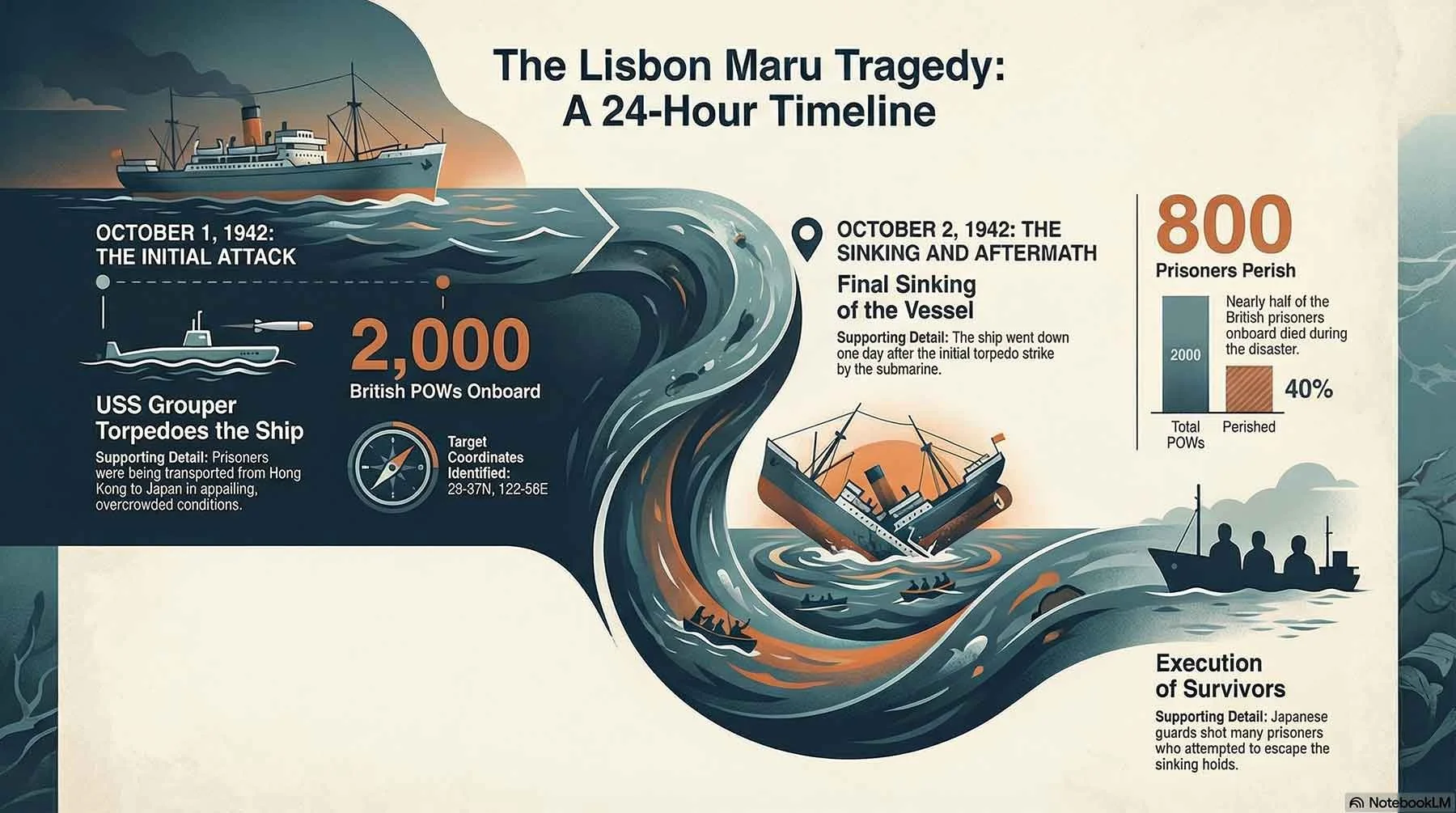
In 1942, Lisbon Maru became one of the most tragic Hellship disasters involving British prisoners of war. A Japanese freighter used to transport POWs captured after the fall of Hong Kong, it sailed north on 27 September 1942 carrying 1,816 British POWs bound toward Shanghai and Japan. On 1 October 1942, off the Zhoushan Islands near the Chinese coast, the unmarked ship was torpedoed by the American submarine USS Grouper, whose crew had no way of knowing Allied prisoners were aboard. Over the next day, as the damaged ship sank and Japanese guards kept many prisoners confined below decks, 828 British POWs died. The courage of local Chinese fishermen, who rescued many survivors, has remained central to the ship’s legacy ever since.
Technical Specifications
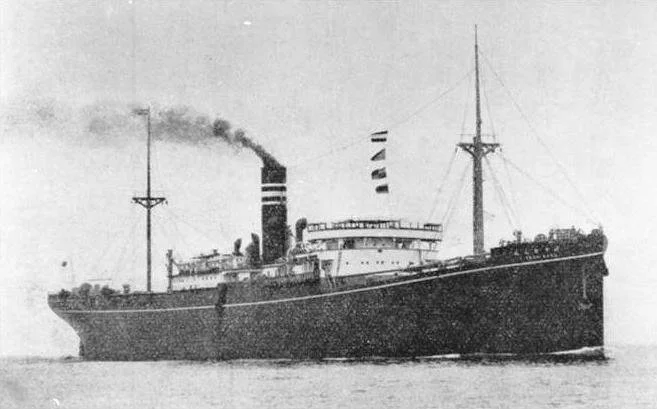
Lisbon Maru was originally constructed as a commercial freighter before being pressed into military service by the Japanese government as a troop transport. She belonged to the Lyons Maru Class of ships, a group of freighters built between 1914 and 1921 from virtually identical blueprints. Her sister ships in this class included Lima Maru, Maebashi Maru, and Toyama Maru, all of which were also used as Hellships during the conflict.
Lisbon Maru was a sizable vessel for her era, measuring 445 feet in length and displacing 7,053 gross tons. Powered by reliable engines capable of reaching up to 14.5 knots, she was designed for efficiency and cargo capacity. However, these very dimensions—large, deep cargo holds meant for inanimate goods—made her a terrifyingly efficient floating dungeon when repurposed by the Japanese military to hold thousands of captive men.
The Ship
By late 1942, it was being used to move British POWs from Hong Kong deeper into the Japanese wartime labor system. Like other ships later remembered as Hellships, it was not marked to indicate the presence of prisoners of war, despite sailing through waters where Allied submarines were actively attacking Japanese shipping. The ship later became one of the best-known symbols of the suffering of British POWs in East Asia.
The Last Voyage
Following the fall of Hong Kong in December 1941, many British and Commonwealth servicemen were taken prisoner. On 27 September 1942, a selected group of 1,816 British POWs was moved from Hong Kong and loaded onto Lisbon Maru. Lisbon Maru Memorial Association (LiMMA) notes that the ship sailed from Hong Kong at daybreak, carrying men from several services and units, including the Royal Navy, Royal Marines, Hong Kong Royal Naval Volunteer Reserve, the Middlesex Regiment, the Royal Scots, the Winnipeg Grenadiers, and others.
These prisoners were viewed entirely as commodities to be exploited as forced labor to sustain the Japanese war machine. The British POWs were herded into the deep, dark cargo holds of the Lisbon Maru in Hong Kong. The vessel was destined for Shanghai, from where the prisoners would ultimately be sent to Japan or other territories to perform slave labor.
The Fatal Attack
As Lisbon Maru steamed north through the East China Sea, it carried no red crosses or specific markings to indicate that it was transporting non-combatant prisoners of war. Because it was unmarked and carrying Japanese troops alongside the prisoners, it was a fully legitimate target under the rules of unrestricted submarine warfare. On October 1, 1942, the American submarine USS Grouper (SS-214) intercepted the transport at coordinates 29°57'N, 122°56'E.
The commander of USS Grouper had absolutely no idea that the hull of his target contained nearly two thousand British allies. This fatal disconnect was a tragic hallmark of the Allied intelligence apparatus. Even when highly classified "Ultra" intelligence intercepts revealed the movements and daily POW counts of Japanese convoys, details regarding the presence of POWs or civilians were routinely excised from the operational briefings passed down to submarine commanders. This was done to protect the closely guarded secret that the Japanese codes had been broken. Operating in the dark regarding the human cost of their strike, the crew of USS Grouper fired their torpedoes.
The torpedoes struck Lisbon Maru with devastating force, crippling the large vessel. However, the ship did not sink immediately. It remained agonizingly afloat for an entire day, leaving the desperate British prisoners trapped in the dark, flooding holds. Lisbon Maru finally succumbed to its catastrophic damage and sank the following day, on October 2, 1942.
Casualties and Survivors
The sinking of Lisbon Maru resulted in massive casualties, but the staggering death toll was not caused by the torpedo strike and drowning alone. The tragedy was exponentially worsened by the active malice and cruelty of the Japanese guards stationed aboard the ship. As the crippled vessel began its final descent and the terrified British prisoners fought their way out of the holds to abandon ship, they were met with lethal violence.
Rather than assisting the helpless, shipwrecked men or allowing them to swim to safety, the Japanese guards systematically opened fire on the escaping prisoners. Many of the POWs were shot or otherwise deliberately murdered by the guards as they struggled in the water or attempted to climb onto the deck. This cold-blooded slaughter of men in the water was a direct and flagrant violation of international law, specifically the Hague Convention of 1907, which strictly banned the killing of shipwreck survivors under any circumstances.
Out of the 1,816 British prisoners of war aboard Lisbon Maru, a staggering 842 perished in the sinking and the subsequent massacre. The surviving prisoners, having endured the squalor of the holds, the terror of the torpedo attack, and the murderous gunfire of their captors, were eventually rounded up by the Japanese and forced to continue their brutal captivity as slave laborers.
Legacy and Memorialization
The destruction of Lisbon Maru remains one of the darkest and most heartbreaking chapters of the Pacific War, a stark reminder of the devastating collateral costs of victory and the absolute vulnerability of the prisoners of war. The deliberate murder of the surviving POWs by the Japanese guards places Lisbon Maru alongside other infamous hell ship massacres, such as Shinyo Maru and Suez Maru, where captors systematically executed their prisoners in the water rather than allowing them a chance at survival.
Today, the tragic voyage of Lisbon Maru is preserved in solemn remembrance by historians, descendants, and memorial organizations dedicated to honoring the Far East prisoners of war. The incident is prominently documented in the archives of COFEPOW (Children of Far East Prisoners of War), which maintains historical records and survivor testimonies regarding "The Lisbon Maru Tragedy" to ensure that the suffering of these British soldiers is never forgotten. The 842 men who lost their lives in the East China Sea stand as a permanent testament to the immense, often unquantifiable human cost of World War II, perishing not only from the weapons of their allies but from the merciless cruelty of their captors
Sources
Lisbon Maru Memorial Association, LiMMA home page
Lisbon Maru Memorial Association, On Board the Lisbon Maru / sinking timeline
Lisbon Maru Memorial Association, Background to the UK memorial
Imperial War Museums, The Sinking of Prisoner of War Transport Ships in East Asia
Lisbon Maru Memorial Association, Further information/bibliography
Related pages