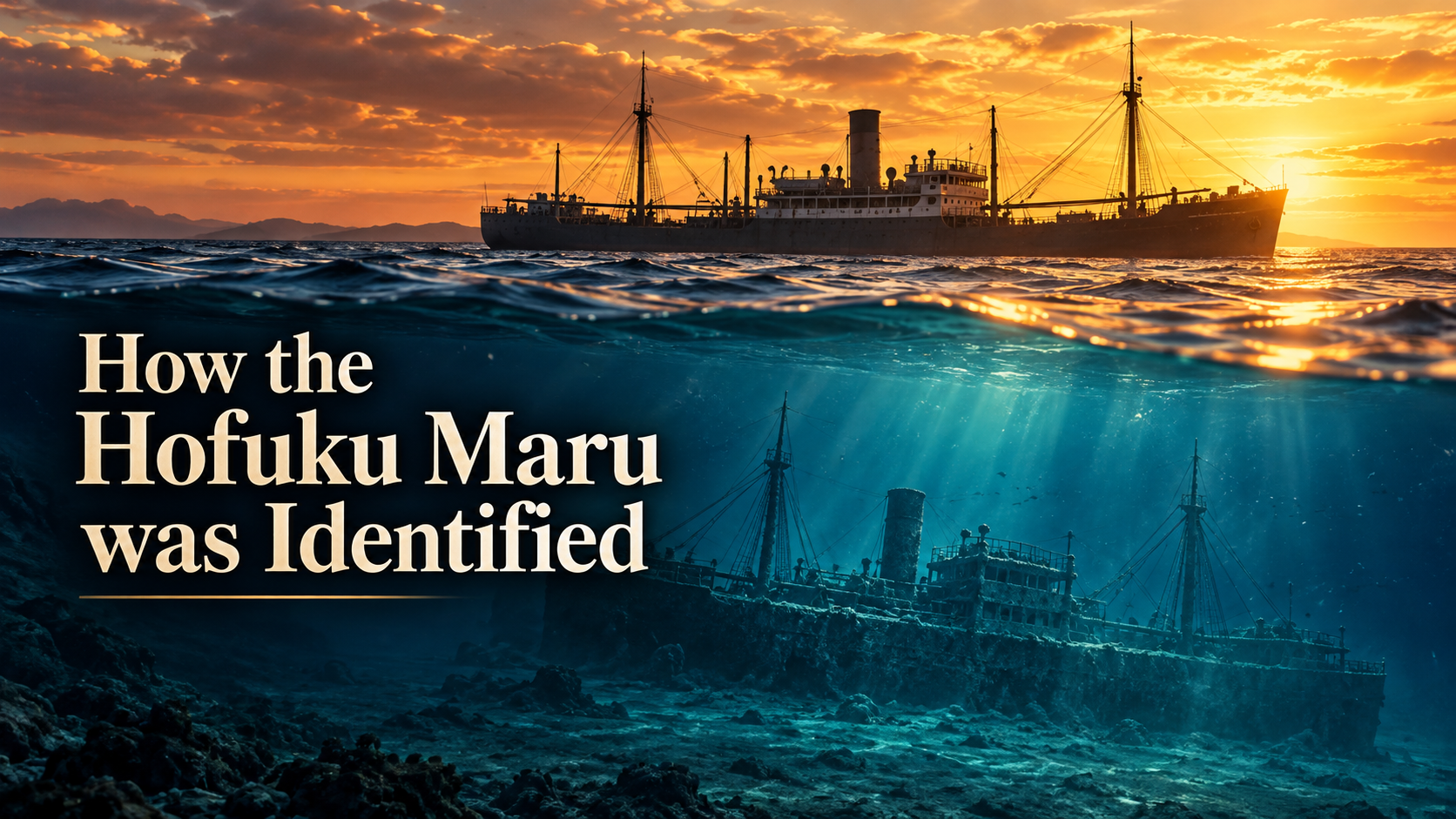
Hōfuku Maru
The WWII Hellship identified off San Narciso, Zambales, in 2026
The Hōfuku Maru was a Japanese cargo ship used to carry Allied prisoners of war. On 21 September 1944, U.S. Navy carrier aircraft sank her off the west coast of Luzon, Philippines. More than 1,000 of the 1,289 British and Dutch POWs in her holds died.
For 80 years, records placed the sinking off Masinloc, about 35 nautical miles north of the true site. In 2025 and 2026, the Hellships Memorial Foundation (HMF) traced a Japanese after-action report to an unidentified wreck off San Narciso, Zambales.
Key facts
Type: Dai-ichi Taifuku-class cargo ship, 5,857 GRT
Built: 1918, Kawasaki Dockyard, Kobe (yard no. 423) Also recorded as
Hohuku Maru, Taifuku Maru No. 31, Hofuku Maru
Final convoy: MATA-27, Manila to Japan, departed 20 September 1944
Sunk: 21 September 1944, by U.S. Navy carrier aircraft
POWs aboard: 1,289 British and Dutch
Deaths: 1,005 to 1,047
Survivors: 242 to 284
Wreck location: Off La Paz, San Narciso, Zambales, Philippines, north of Capones Island
Depth: About 52 m (170 ft)
Identified by: Hellships Memorial Foundation, 2025–2026
Status: Maritime war grave; exact coordinates withheld
The ship
Kawasaki built the Hōfuku Maru in Kobe in 1918. Her first notable voyage carried German POWs, captured at Tsingtao in 1914, home to Germany in 1920. She then worked as a merchant ship, was renamed Hohuku Maru in 1937, and was requisitioned by the Imperial Japanese Army in October 1941.
The final voyage
In mid-1944 the ship left Singapore in convoy SHIMI-05 with British and Dutch POWs bound for forced labor. Engine trouble forced her to leave the convoy at Borneo. She reached Manila on 19 July 1944 and stayed about two months under repair. The prisoners remained in the holds the whole time, suffering from disease, hunger and thirst.
On 20 September 1944 she sailed for Japan as the second merchant ship in Convoy MATA-27, escorted by Kaibōkan No. 1 (CD-1).
The sinking
On the morning of 21 September 1944, more than 100 U.S. Navy carrier aircraft, including Helldivers and Avengers from USS Bunker Hill, attacked the convoy. All eleven ships were sunk. A bomb struck the Hōfuku Maru's stern and a torpedo hit amidships. She broke in two and sank within minutes.
Like other Hellships, she carried no markings showing that prisoners were aboard. The American aircrews had no way to know. Most POWs were trapped below deck. Survivors swam toward the Zambales shore or were picked up by Japanese escorts.
How the wreck was found
The wreck was identified by matching a Japanese wartime report to a wreck local divers already knew, then testing that match against the ship's blueprints and battle damage.
1944–2016
Official histories place the sinking off Masinloc. Fishermen off La Paz, San Narciso, know of a large steel wreck they call "the Maru."
2016–2017
Resort owner Matt Gillan and the Sea Scan Survey team scan and dive the wreck. They find a cargo ship in two sections, buried in volcanic silt, but cannot name it.
June 2025
HMF researcher John Duresky, searching Japan's JACAR archive for a lost U.S. Navy Hellcat pilot, finds CD-1's after-action report for Convoy MATA-27. It places the Hōfuku Maru's sinking 35 nautical miles south of the accepted site.
June 2025
Randy Anderson and Tim Beckensall match the report's position and landmarks to the La Paz wreck.
Late 2025 – early 2026
HMF, supported by the RCE and the Discovery Channel, surveys the site with side-scan sonar, ROVs, divers and 3D photogrammetry.
8 June 2026
The RCE reviews the team's report and states the wreck is almost certainly the Hōfuku Maru.
The HMF team: Gerald "Randy" Anderson, Timothy Beckensall, John Duresky, Kevin Hamdorf and Rhonie Dela Cruz. Underwater imaging was led by archaeologist [FIRST NAME] Mires and imaging specialist Evan Kovacs.
The evidence
Four independent lines of evidence point to the same ship:
Dimensions. The wreck measures about 377 ft long with a 51.85 ft beam and 2 ft frame spacing. These match Kawasaki's plans for a Dai-ichi Taifuku-class freighter.
Damage. The wreck lies in two sections about 50 m apart, with severe stern damage. This matches U.S. aircraft action reports and survivor accounts of a stern bomb hit followed by a torpedo amidships.
POW death records. Japanese registration cards for British and Dutch victims give a place of death within 175 m of the wreck.
Elimination. The Hōfuku Maru was the only Taifuku-class ship and the only POW transport in Convoy MATA-27. No other wreck of that period lies on this stretch of coast.
A protected war grave
The Hōfuku Maru is a grave for the men who died in her holds. The governments of the United Kingdom, the Netherlands and the United States have been notified. Her exact coordinates are not published, to protect the site from disturbance.
The wreck faces a slower threat: volcanic ash from the 1991 Mount Pinatubo eruption keeps washing down rivers and settling over it. The 3D survey records the wreck as it is today.
Search the names
The men lost on the Hōfuku Maru are listed in the Global Hellships Casualty Roster. Families with records, photos or letters can contact us at info@hellshipsmemorial.org to add to a man's entry. A plaque for the Hōfuku Maru stands at the Hellships Memorial in Subic Bay.
Frequently asked questions
What was the Hōfuku Maru?
A Japanese cargo ship built in 1918 and used in World War II to transport Allied prisoners of war. Survivors called these ships Hellships.
When and how was the Hōfuku Maru sunk?
On 21 September 1944, U.S. Navy carrier aircraft bombed and torpedoed her while she sailed from Manila to Japan in Convoy MATA-27. The ship was not marked as carrying POWs.
How many prisoners died on the Hōfuku Maru?
Of the 1,289 British and Dutch POWs aboard died.
Where is the Hōfuku Maru wreck?
Off La Paz, San Narciso, in Zambales province on Luzon, Philippines, at about 52 m depth. The exact position is withheld to protect the war grave.
Who found the Hōfuku Maru?
The Hellships Memorial Foundation identified the wreck in 2025–2026, with support from the Cultural Heritage Agency of the Netherlands and the Discovery Channel. Local divers and the Sea Scan Survey team had first scanned the then-unnamed wreck in 2016–2017.
Can people dive the wreck?
The site is a war grave and should not be disturbed. Its coordinates are not public.
How can I find a relative who was aboard?
Search the Global Hellships Casualty Roster or email info@hellshipsmemorial.org.
Sources
Japan Center for Asian Historical Records (JACAR): Kaibōkan No. 1 (CD-1) after-action report, Convoy MATA-27, 21 September 1944
U.S. Navy aircraft action reports, USS Bunker Hill air group, 21 September 1944
Japanese POW registration cards for British and Dutch prisoners
Kawasaki Dockyard plans, Dai-ichi Taifuku-class cargo ship
Cultural Heritage Agency of the Netherlands (RCE), statement of 8 June 2026
In the news
CNN, 18 June 2026: Discovery of WWII wreck reveals story of 'hell ship' used to transport POWs
Popular Science: Long-lost World War II 'Hellship' may have finally been found
Baird Maritime: Wreck of WW2 Japanese prison ship found off Philippines
Related pages