Enoura Maru
The history of the Japanese "hell ships" during the Second World War is a dark chronicle of human suffering, forced labor, and tragic friendly fire. Among the 134 Japanese vessels that transported roughly 126,000 Allied prisoners of war (POWs) across the Pacific, Enoura Maru occupies a particularly harrowing place. Serving as a secondary prison transport for the severely weakened survivors of the infamous Oryoku Maru, Enoura Maru became the site of yet another massive loss of life when it was attacked by American aircraft in early 1945.
The Ship
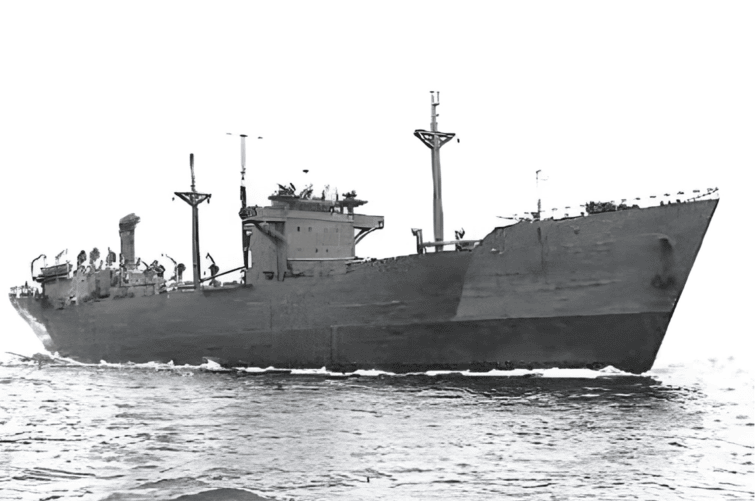
Like the vast majority of hell ships, Enoura Maru was a merchant vessel requisitioned by the Japanese military to sustain its wartime logistics. The Empire of Japan relied heavily on these ships to transport extracted raw materials and to relocate massive numbers of captured Allied personnel and Asian forced laborers (rōmusha) to industrial centers in Japan, Korea, Manchuria, and Formosa.
The conditions forced upon the prisoners aboard vessels like Enoura Maru were universally deplorable. Prisoners were crammed into tight, unventilated cargo holds with little to no air. They were frequently denied access to adequate food, drinking water, and bathroom facilities. Within these floating dungeons, terminal dehydration, starvation, hyperthermia, and asphyxia claimed many lives, while Japanese guards routinely subjected the prisoners to excessive beatings and summary executions. By late 1944, as American forces advanced to reconquer the Philippines, the Japanese military frantically attempted to evacuate POWs toward the Home Islands. In their haste, they massively overloaded their requisitioned merchant vessels, causing the already abysmal conditions in the holds to deteriorate with terrifying speed.
Key Facts
Type/Class: Wartime Standard Cargo ship, specifically a Modified A (or 2A) Class freighter. These ships were designed for mass production rather than commercial economy and lacked double bottom compartments.
Operator: Nippon Yūsen Kaisha (NYK Line).
Completion Date: March 30, 1944.
Tonnage: Sources vary slightly, listing the standard 2A class weight at 6,600 gross register tons (with an 11,200 deadweight tonnage). However, specific estimates for Enoura Maru generally place its gross tonnage at 6,968 tons.
Length: Approximately 448 feet and 8 inches (136.75 to 136.79 meters).
Beam/Width: Approximately 59 feet and 8 inches (18.19 to 18.22 meters).
Draught: 36 feet and 5 inches (11.10 to 11.12 meters).
Machinery/Propulsion: 1-shaft steam turbine with 3 boilers.
Engine Power: 3,500 shaft horsepower (shp).
Speed: A maximum speed of 13 knots, though typical speeds ranged between 10 and 13 knots.
Range: 4,000 nautical miles at a speed of 9.5 knots.
The Voyage
Enoura Maru's most notable and tragic voyage was inextricably linked to the horrific journey of another hell ship, Oryoku Maru. Oryoku Maru had departed Manila on December 13, 1944, carrying 1,620 POWs—predominantly Americans who had survived the Bataan Death March and the battles of Corregidor. Over the next two days, the ship was bombed and sunk by American aircraft in Subic Bay, killing approximately 270 prisoners.
The survivors of this sinking were herded onto an open tennis court at the Olongapo Naval Base, subjected to severe mistreatment, and later transported to San Fernando, Pampanga. There, 15 wounded men were deceptively taken to a cemetery and systematically beheaded by Japanese guards. The remaining, traumatized prisoners were then moved by train to the coastal port of San Fernando, La Union, to resume their agonizing journey north by sea.
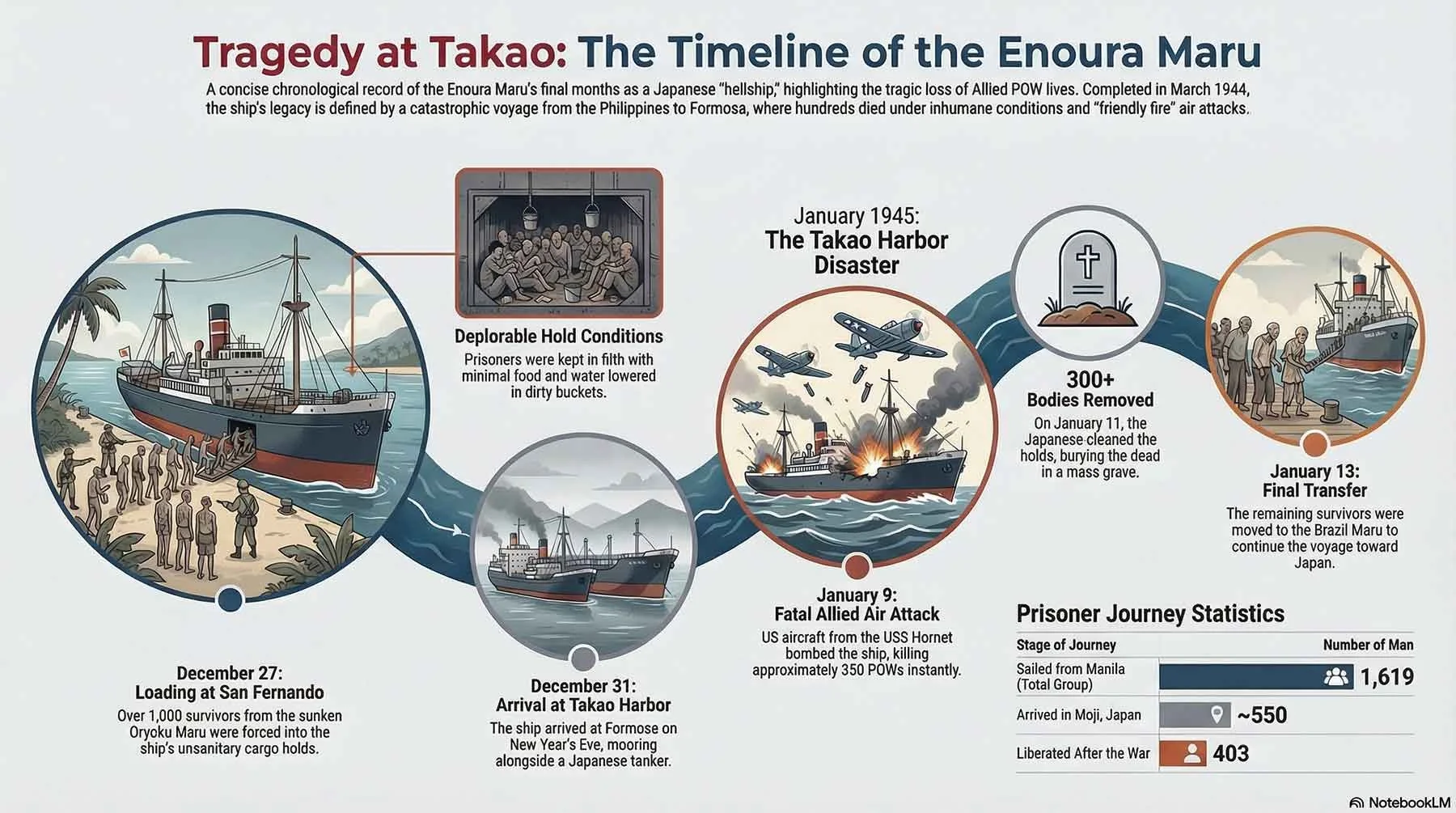
At this port, the Japanese military divided the survivors. About 1,000 of the POWs were loaded onto the Enoura Maru, while the rest were placed aboard the smaller Brazil Maru. Navigating through dangerous waters actively hunted by Allied submarines and aircraft, both Enoura Maru and Brazil Maru managed to reach Takao (present-day Kaohsiung) harbor in Taiwan on New Year's Day, 1945.
The severely weakened POWs remained confined within the ships while docked in the harbor. On January 6, 1945, the Japanese initiated a transfer of the human cargo, moving the smaller group of prisoners from Brazil Maru onto the already packed Enoura Maru. During this reshuffling, 37 British and Dutch prisoners were taken ashore. The consolidation of almost all the remaining prisoners onto Enoura Maru concentrated the suffering men into a single, incredibly vulnerable target.
The Attack
Despite the horrific abuses inflicted by the Japanese guards, the greatest cause of fatalities aboard the hell ships was unintentional "friendly fire" attacks from Allied submarines and aircraft, which inadvertently killed more than 19,000 captive passengers during the war.
This was the result of a fatal bureaucratic disconnect within the Allied intelligence network. The Allies had constructed an immense intelligence apparatus, utilizing the Joint Intelligence Center Pacific Ocean Area (JICPOA) and global codebreakers—such as those at Bletchley Park—to intercept and decode Japanese daily maritime radio transmissions. This allowed Allied forces to accurately track the movements of Japanese merchant fleets. However, as this intelligence was processed into highly classified "Ultras" for theater commanders, any details regarding the presence of Allied POWs were intentionally excised to protect the closely guarded secret that the Japanese codes had been broken. Consequently, American pilots and submarine commanders had absolutely no idea that their targets contained thousands of their own captured men.
This intelligence gap doomed the prisoners trapped aboard the Enoura Maru. On January 9, 1945, while the ship sat disabled in Takao harbor, American aircraft launched a fierce assault. Dive-bombers from the aircraft carrier USS Hornet—the exact same carrier whose planes had destroyed Oryoku Maru weeks earlier—attacked Enoura Maru. The bombing inflicted severe damage on the vessel and caused devastating carnage within the packed holds.
Casualties and Survivors
The American aerial attack on Enoura Maru resulted in the deaths of approximately 350 to 400 Allied POWs. The men who perished in Takao harbor had endured the Bataan Death March, survived the sweltering holds and sinking of Oryoku Maru, and lived through the atrocities in San Fernando, only to be killed by American bombs while trapped in a Taiwanese port.
Following the devastating bombing, the Japanese military once again reorganized the surviving prisoners. The men who lived through the attack on Enoura Maru were removed from the disabled vessel and consolidated back onto the Brazil Maru. Brazil Maru then continued the grim journey, departing Formosa on January 14, bound for Japan. This final leg of the journey was agonizing. The ship sailed into freezing winter weather and snow, and the POWs were denied adequate food, water, or medical care for their wounds. As a result of starvation, untreated injuries, and disease, the men died at an alarming rate of 20 to 50 per day, and their bodies were unceremoniously thrown overboard. Finally arriving in Moji, Japan, on January 29, 1945.
By the time the ship docked, Japanese medics were visibly shocked by the wasted, skeletal condition of the POWs. Out of the original 1,620 men who had boarded Oryoku Maru in Manila, only about 549 or 550 were still alive to step off Brazil Maru in Japan. The suffering did not end there; the men were sent to primitive military hospitals and forced labor camps scattered across Japan, Taiwan, and Korea, where an additional 150 men died from their maltreatment in the following months. Ultimately, only 403 survivors of this horrific multi-ship journey lived to be liberated by Allied forces at the end of the war
After arriving in Moji, Japan, on January 28 or 29, 1945, the surviving Allied prisoners of war were disembarked from the ship. Japanese medics were shocked by the skeletal, wasted condition of the POWs and used triage to divide the men. The 110 most severe medical cases were sent to a primitive military hospital in Kokura, where 73 died within a month, while the remaining prisoners were distributed to various forced labor camps across Japan and Korea.
As for the vessel itself, the 5,859-ton Brazil Maru continued its maritime service for only a few more months. It was ultimately sunk by a United States Army mine on May 12, 1945, at coordinates 34-40N, 135-12E.
Legacy and Memorialization
Enoura Maru represents a profound tragedy within the broader narrative of the Pacific War. While it is often discussed strictly as the second chapter of Oryoku Maru disaster, its history is an integral part of the horrific hell ship network that claimed so many Allied lives at sea. It stands as a grim monument to the fatal consequences of the Allied intelligence bureaucracy, which inadvertently directed American firepower against captive American servicemen.
Following the war, the orchestrators of this agonizing journey faced justice during the 1946 Yokohama war crimes trials. Junsaburo Toshino, the Guard Commandant who oversaw the transport operations, was sentenced to death as a Class B war criminal and hanged in 1948. The official interpreter, Shuske Wada, was sentenced to life imprisonment at hard labor for his lethal negligence in denying the prisoners adequate food, water, and medical care throughout their ordeal. Although these verdicts offered a measure of postwar accountability, the destruction of Enoura Maru remains a deeply somber reminder of the absolute disregard for human life that defined the Japanese hell ships, and the devastating collateral costs of the Second World War
Sources
Defense POW/MIA Accounting Agency, Enoura Maru Info Sheet
U.S. National Archives, “American POWs on Japanese Ships Take a Voyage into Hell”
Department of Veterans’ Affairs (Australia), Taiwan Hellships Memorial
POW Research Network Japan, Enoura Maru
DPAA Hellship losses project summary PDF
Related pages