

Profiles of Japanese Guards
Introduction to Documented Cases
While the overall system of POW administration shaped conditions across camps and Hellships, individual guards and command personnel played a decisive role in how that system functioned in practice. Postwar investigations and war crimes trials provide insight into specific individuals whose actions were documented in detail.
These cases do not represent all guards, but they illustrate how authority, training, and circumstance translated into real-world behavior.
Key Facts:
Mutsuhiro Watanabe (“The Bird”) — Omori and Naoetsu Camps
One of the most well-documented figures associated with POW camp administration was Mutsuhiro Watanabe, commonly referred to by prisoners as “The Bird.”
Watanabe served at several camps in Japan, including Omori and Naoetsu. Survivor testimonies describe him as holding a position of authority despite not being a commissioned officer. His role placed him in frequent contact with prisoners, including officers and enlisted men.
Accounts from former POWs—including Louis Zamperini—describe repeated physical punishment and strict enforcement of discipline. Watanabe’s behavior became a focal point in postwar investigations, though he initially avoided capture and was never formally tried in court.
His case illustrates how individuals in relatively informal positions of authority could exert significant control over daily camp life.
Among the most detailed accounts of guard behavior comes from Louis Zamperini, who was held in multiple Japanese camps, including Omori and later Naoetsu.
Zamperini described repeated encounters with the guard known as “The Bird,” later identified as Mutsuhiro Watanabe. His testimony emphasizes not only physical punishment but also the role of personal authority within the camp hierarchy.
Zamperini’s account illustrates how, within a decentralized system, individual guards could shape prisoners’ daily experience far beyond formal rank or regulation.
Sadaaki Kuroda — Fukuoka Camp System
Sadaaki Kuroda was a Japanese civilian employee attached to the Fukuoka POW camp system, which included multiple subcamps supporting industrial labor.
Kuroda was later tried by Allied military authorities and convicted of mistreatment of prisoners. Testimony presented during proceedings described:
Physical abuse of POWs
Harsh enforcement of labor discipline
Participation in punitive measures
His case highlights the involvement not only of military personnel but also of civilian officials in the administration of POW labor systems.
Yoshitaka Kumagai — Camp Administration and Abuse Charges
Yoshitaka Kumagai served in a supervisory role at a Japanese POW camp and was later prosecuted for his treatment of prisoners.
Trial records indicate that Kumagai was accused of:
Direct physical abuse
Participation in disciplinary beatings
Failure to intervene in mistreatment
He was convicted and sentenced by Allied authorities.
This case demonstrates how responsibility could extend beyond direct actions to include failure to prevent abuse within the chain of command.
Hellship Guards — The Case of the Oryoku Maru
While fewer individual names are as widely documented for Hellship guards, survivor accounts from transports such as the Oryoku Maru provide insight into their role.
During the transport of POWs from the Philippines in December 1944:
Guards controlled access to air and water
Prisoners were confined below deck under extreme conditions
Punitive measures were reported in response to attempts to access ventilation or escape overcrowding
Postwar investigations into the Oryoku Maru and related transports examined the conduct of guards and officers involved, though documentation was often incomplete.
These accounts suggest that guard behavior during transport was shaped not only by individual disposition but also by the constraints and priorities of the transport system itself.
Variation Across Camps and Units
Not all documented cases involve extreme abuse. Some records indicate that:
Certain guards adhered more closely to regulations
Limited acts of restraint or assistance occurred
Conditions varied depending on leadership and location
However, such cases are less frequently represented in trial records, which tended to focus on violations.
The Role of War Crimes Trials
Following the war, Allied authorities conducted numerous trials addressing the treatment of POWs. These proceedings:
Collected survivor testimony
Examined camp records and command structures
Assigned responsibility to individuals where evidence supported prosecution
The trials revealed both patterns of behavior and the degree to which individuals operated within—or exceeded—the expectations of their roles.
Conclusion
Documented cases of Japanese guards provide a more detailed understanding of how POW treatment was carried out on the ground. They show that while systemic factors created the conditions, individual actions shaped the lived experience of prisoners.
By examining these profiles, it becomes possible to connect broader historical analysis with specific, verifiable instances of conduct—adding depth and clarity to the overall narrative of the Hellships and POW system
Q: Who were the Japanese POW guards in WWII?
Japanese POW guards were typically Imperial Japanese Army soldiers, reservists, or lower-ranking personnel assigned to oversee prisoners in camps and transport ships.
Q: Were all Japanese guards cruel to POWs?
No. While many POWs reported harsh treatment, behavior varied depending on individual guards, leadership, and conditions within each camp.
Q: Who was “The Bird” in WWII?
Mutsuhiro Watanabe, known as “The Bird,” was a Japanese POW camp guard noted in survivor accounts for strict and often abusive treatment of prisoners.
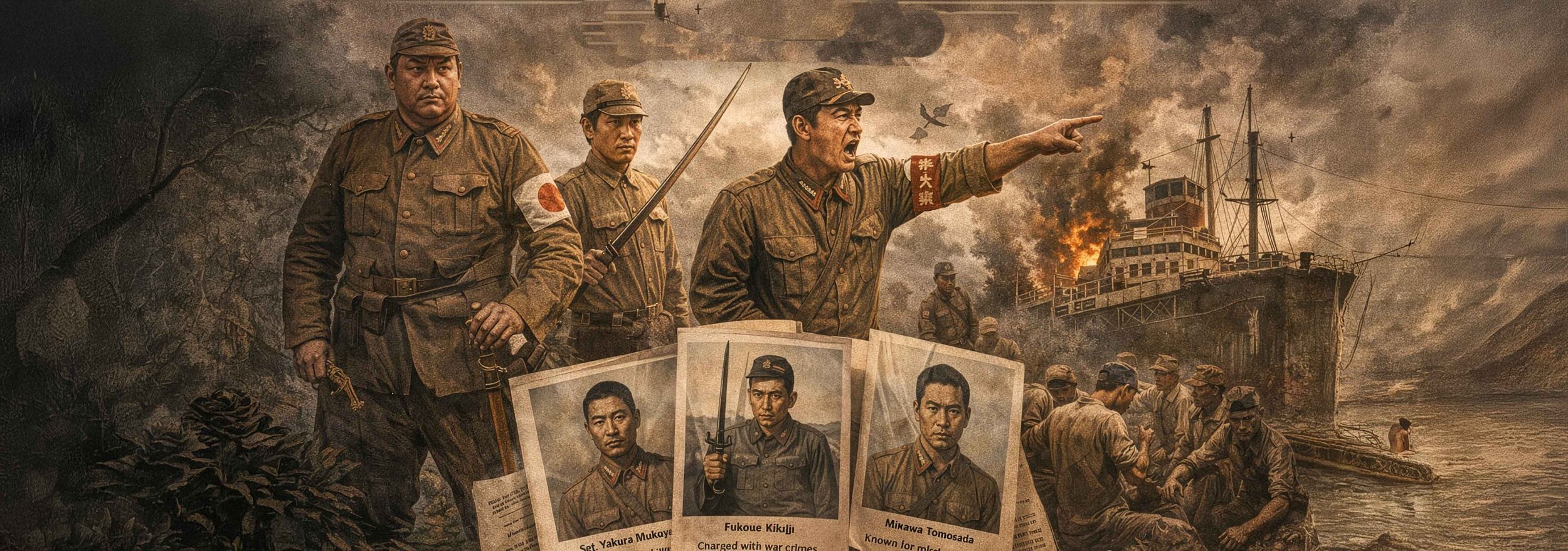
• Guards were often reservists or lower-ranking soldiers
• Training emphasized discipline and obedience
• Behavior varied widely by location
• Some were prosecuted after the war
“He would single me out… and it would go on for minutes.”
“Strength alone was not enough”
Filipino Civilians and Guerrillas
Inside the Hellships (conditions)
War Crimes Trials