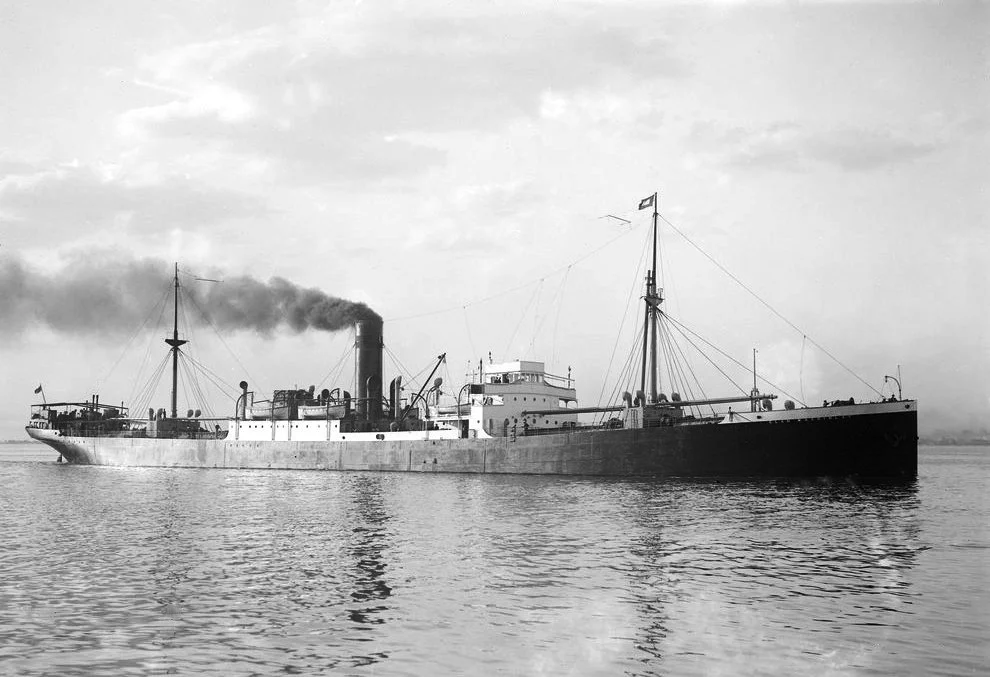
Shin’yō Maru
In 1944, Shin’yō Maru became one of the deadliest Hellship disasters involving American prisoners of war in the Philippines. A Japanese cargo ship used as a POW transport, it carried about 750 American prisoners, most of them from Davao Penal Colony on Mindanao, together with Japanese troops and cargo. On 7 September 1944, off the west coast of Mindanao near Sindangan Point, the unmarked ship was torpedoed by the American submarine USS Paddle, whose crew had no way of knowing Allied POWs were aboard. Hundreds of prisoners were killed in the explosions, drowned in the sinking, or were shot in the water, while a small number reached shore with the help of local Filipinos.
The Ship
Shin’yō Maru was a Japanese cargo vessel requisitioned for wartime transport service. By 1944, it had been drawn into Japan’s prisoner transport system, moving American POWs through the southern Philippines toward larger shipping routes connected to Manila. Like other Hellships, it was not marked to indicate that prisoners of war were aboard, even though it was moving through waters under active American submarine patrol. That failure to identify POW transports was central to the tragedy that followed.
The Voyage
The prisoners later placed aboard Shin’yō Maru were primarily American POWs from Davao Penal Colony, including men who had worked on Japanese airfields at Lasang and south of Davao. According to the National Archives account, the 750 prisoners were marched shoeless to Tabunco pier on 19 August 1944 and packed aboard a ship on 20 August. After reaching Zamboanga on 24 August, they remained in miserable conditions for days before being transferred to Shin’yō Maru on 4 September. The holds were foul, overcrowded, and dangerously hot; prisoners suffered heat rash, blackouts, and extreme filth, with only limited opportunities to come topside. On 7 September, hatch covers were secured more tightly to prevent lifting from below, and the ship sailed northward for Manila via Cebu.
The Attack and Loss
At 4:37 p.m. on 7 September 1944, USS Paddle sighted the convoy off Sindangan Point, on the west coast of Mindanao, and fired torpedoes at Shin’yō Maru. The explosions tore through the ship and collapsed heavy material into the prisoner holds. Survivors described mangled bodies, dust-filled air, and desperate attempts to climb to the deck. Men who escaped into the water found that surviving Japanese soldiers fired on Americans swimming away from the sinking ship or trying to emerge from the holds. The National Archives account records that the ship was lost in the torpedo attack and that a group of survivors managed to swim ashore, where local Filipinos and the “Volunteer Guards” helped them evade recapture and eventually return to U.S. control.
Casualties and Survivors
The public sources differ slightly in their totals, and that should be noted on the page. The National Archives article gives 750 American POWs aboard and states that eighty-three survivors made it ashore with Filipino help. The POW Research Network Japan states that of the 750 POWs, most were killed in the explosion or drowned, and nearly all who escaped the ship were shot by Japanese soldiers; that source records 83 survivors and therefore implies about 667 deaths. The National Archives also reproduces wartime intelligence summaries listing 667 casualties for Shin’yō Maru, which is broadly consistent with that total.
Only about 82 POWs survived out of the hundreds aboard, many reaching shore with the help of Filipino guerrillas, while the vast majority were killed either by the torpedo attack, drowning, or deliberate execution by guards. The submarine crew did not know POWs were on board and only learned of the tragedy after the war, making the incident one of the most tragic examples of “friendly fire” combined with Japanese brutality during the hellship transports
Legacy and Memorialization
Shin’yō Maru holds an important place in Hellship history because it illustrates several of the central patterns of the Hellship tragedy at once: overcrowded and brutal transport conditions, the danger of unmarked POW ships in combat zones, and the killing of prisoners even after they escaped into the sea. It is also significant in Philippine wartime memory because the survivors who reached shore were aided by local Filipinos, linking the ship’s story to the broader history of resistance and civilian courage in Mindanao. For researchers and descendants, Shin’yō Maru remains a key chapter in the story of American prisoners moved out of the southern Philippines in 1944.
Sources
U.S. National Archives, “American POWs on Japanese Ships Take a Voyage into Hell”
POW Research Network Japan, Shinyo Maru
Related pages
Arisan Maru
The Philippine Hellship Convoys
Hellships Casualty Database
Hellships Survivor Records
Hellships Research Center
Hellships Researcher Guide