

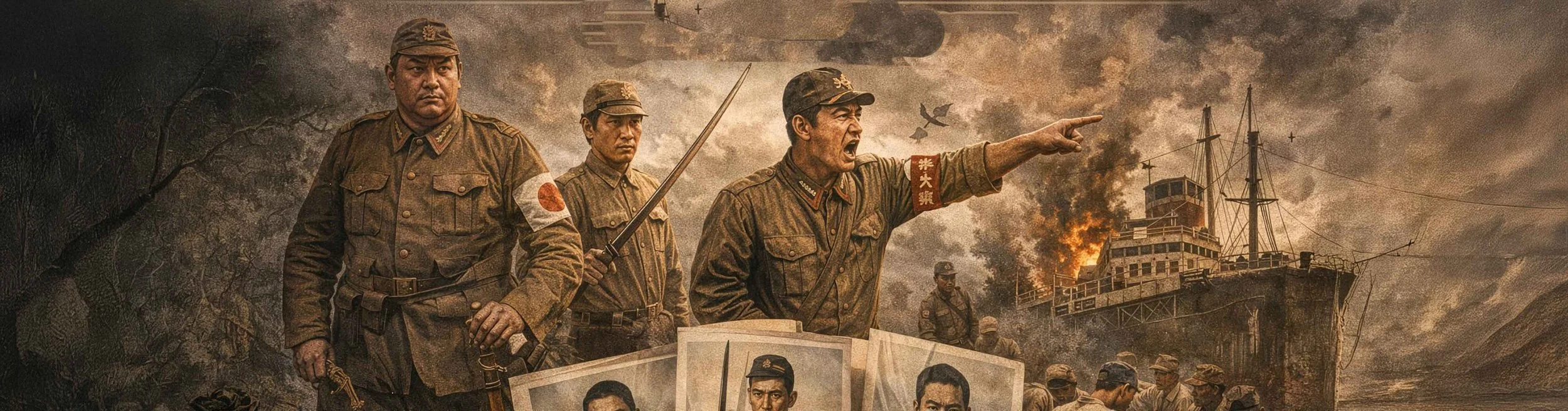
Who Were the Japanese Guards?
Understanding the Men Who Oversaw Allied POWs
Beyond the Image of the Guard
In the collective memory of the Pacific War, the figure of the Japanese prison camp guard has often been reduced to a single image—unyielding, severe, and defined primarily by cruelty. Survivor accounts, postwar trials, and popular narratives have reinforced this perception, shaping an enduring archetype. Yet history, when examined closely, reveals a more complex reality.
Japanese guards were not a uniform class of individuals. They were drawn from different backgrounds, shaped by varying levels of training, and placed within a system that itself lacked cohesion and consistency. Their behavior—sometimes harsh, sometimes restrained, and often dependent on circumstance—was influenced by military doctrine, cultural attitudes, and the pressures of a war increasingly defined by scarcity and strain.
To understand the treatment of Allied prisoners of war, particularly those transported aboard the so-called Hellships, it is necessary to examine not only the conditions of captivity but also the individuals who enforced them. This chapter explores who these guards were, the system in which they operated, and how their actions shaped the daily realities of POW life.
A System Without a Framework
The Imperial Japanese Army entered the Second World War without a comprehensive institutional doctrine for the administration of prisoners of war. Unlike Western militaries, which had developed systems for handling captured personnel during the First World War, Japan’s military planning emphasized offensive operations, endurance, and the expectation that soldiers would not surrender.¹
When mass surrenders occurred—most notably in the Philippines in 1942—the Japanese military was confronted with the logistical and administrative challenge of managing tens of thousands of prisoners. Camps were established rapidly, often in existing facilities or improvised locations. Guard units were assigned, but there was little standardized training specific to prisoner management. Policies were inconsistent, and implementation varied widely.
Authority within this system was highly decentralized. Camp commanders exercised significant autonomy, and guard units operated under local directives rather than a unified set of enforced regulations. As a result, conditions differed markedly between camps, and the behavior of guards was shaped as much by local leadership as by broader military culture.
Who Became a Guard
The composition of guard units reflected the broader needs and constraints of the Japanese military. Many guards were not frontline combat soldiers. Instead, they were often:
Older reservists
Soldiers deemed less fit for combat duty
Personnel recovering from wounds or illness
Lower-ranking troops assigned to rear-area responsibilities
These assignments were sometimes viewed as secondary roles, and the level of training and experience among guards could vary significantly. Some had prior combat experience and a strong sense of discipline; others had limited preparation for managing large groups of prisoners under difficult conditions.
This diversity contributed to inconsistency in the enforcement of rules and the exercise of authority. In a system lacking standardized oversight, individual disposition played a meaningful role.
Training, Discipline, and the Use of Force
Training within the Imperial Japanese Army emphasized obedience, endurance, and strict discipline. Physical punishment was commonly employed as a corrective measure, reinforcing hierarchical authority and compliance.² Recruits were expected to endure hardship without complaint and to accept discipline as a normal aspect of military life.
When soldiers trained in this environment were assigned to guard duties, the methods they had experienced often carried over. The use of physical punishment to enforce compliance was not necessarily viewed as exceptional; rather, it reflected established practices within the military itself.
This normalization of force influenced interactions with prisoners. Guards, operating within a familiar framework of discipline, applied similar methods to maintain order among those under their control.
Perceptions of Surrender
Central to understanding guard behavior is the cultural perception of surrender within the Japanese military ethos. Soldiers were taught that surrender represented a failure of duty and a loss of honor.³ Capture was to be avoided, even at great personal cost.
As a result, prisoners of war were sometimes viewed as having forfeited their status as soldiers. This perception did not dictate uniform behavior, but it shaped attitudes. It could contribute to a diminished sense of obligation toward prisoner welfare and a greater emphasis on control and discipline.
Daily Life: Authority in Practice
The daily responsibilities of guards placed them in constant contact with prisoners. Their duties included:
Conducting roll calls
Supervising labor details
Enforcing camp regulations
Managing access to food, water, and medical care
In many respects, the guard was the primary representative of the system experienced by prisoners. The nature of this interaction—whether strict, indifferent, or occasionally restrained—had a direct impact on daily life.
Authority was exercised through routine and presence. In environments defined by scarcity and confinement, even minor decisions could have significant consequences.
Individuals Within the System
While systemic factors shaped overall conditions, individual guards could exert considerable influence.
One of the most widely documented figures was Mutsuhiro Watanabe, known to prisoners as “The Bird.” Serving at camps such as Omori and Naoetsu, Watanabe held a position of authority despite not being a commissioned officer. Survivor accounts, including those of American POW Louis Zamperini, describe strict enforcement of discipline and repeated use of physical punishment.⁴
Other cases illustrate different aspects of the system. Sadaaki Kuroda, a civilian attached to the Fukuoka camp network, was involved in supervising forced labor and was later convicted in postwar proceedings. Yoshitaka Kumagai, a guard in a supervisory role, was prosecuted not only for direct abuse but also for failing to prevent mistreatment within his unit.
These cases demonstrate that responsibility extended beyond formal rank and that both action and inaction could carry consequences.
Variation Across Camps
Conditions in POW camps were not uniform. Survivor testimonies indicate significant variation, influenced by:
Leadership styles of commanding officers
Availability of food and medical supplies
Geographic and environmental factors
Individual guard behavior
In some camps, discipline was enforced with particular severity; in others, there were instances of relative restraint. This variability underscores the decentralized nature of the system and the importance of local conditions.
Guards on the Hellships
The role of guards took on additional complexity aboard the Hellships. These transport vessels, often overcrowded and poorly ventilated, created extreme conditions for prisoners and guards alike.
Guards were responsible for maintaining order within confined spaces, controlling access to limited resources, and enforcing restrictions on movement. In such environments, their decisions could directly affect survival outcomes.
The absence of standardized procedures, combined with the pressures of transport under wartime conditions, contributed to the severity of these voyages.
War Crimes and Accountability
Following the war, Allied authorities conducted investigations and trials addressing the treatment of POWs. These proceedings documented conditions within camps and transports, collected survivor testimony, and identified individuals responsible for violations.
Charges ranged from direct physical abuse to failure to prevent mistreatment. The concept of command responsibility—holding individuals accountable for actions within their authority—became a key element in these cases.
However, not all individuals were prosecuted, and the historical record remains incomplete. Many actions were documented only through survivor accounts, and some cases were never fully investigated.
Interpreting the Role of Guards
Understanding the role of Japanese guards requires balancing system and individual. Their behavior cannot be attributed solely to personal disposition, nor can it be explained entirely by structural factors. It emerged from the interaction between training, ideology, environment, and circumstance.
Simplified narratives risk obscuring this complexity. A more complete historical understanding acknowledges variation, context, and the limitations of available evidence.
Conclusion: A System Seen Through Individuals
Japanese guards were individuals operating within a military and cultural framework shaped by war, doctrine, and necessity. Their actions—documented through testimony and trial records—reflect both the structure of the system and the choices made within it.
Examining who they were provides insight into how the POW system functioned on a daily level. It connects broader historical forces with lived experience and contributes to a more nuanced understanding of the Hellships and the wider history of captivity in the Pacific War.
Notes
Edward J. Drea, Japan’s Imperial Army: Its Rise and Fall, 1853–1945 (Lawrence: University Press of Kansas, 2009).
Ibid.
Yuki Tanaka, Hidden Horrors: Japanese War Crimes in World War II (Boulder: Westview Press, 1996).
Louis Zamperini and David Rensin, Devil at My Heels (New York: HarperCollins, 2003).