Arisan Maru
During the brutal conflict of the Pacific War, the Imperial Japanese military transported tens of thousands of Allied prisoners of war (POWs) across the ocean to serve as forced laborers in Japan, Manchuria, and other occupied territories. These unmarked transport vessels became infamous among the prisoners as "hell ships" due to their nightmarish, suffocating, and inhumane conditions. Tragically, because these ships were unmarked and actively supporting the Japanese war effort, they became prime targets for Allied submarines and aircraft. Over the course of the war, Allied forces inadvertently killed more than 19,000 of their own captive men in devastating friendly fire incidents. Among these tragic vessels, Arisan Maru stands out as the site of one of the most horrific maritime disasters of World War II. The torpedoing of Arisan Maru in October 1944 remains the largest single loss of American lives at sea in the history of the United States military
Technical Specifications
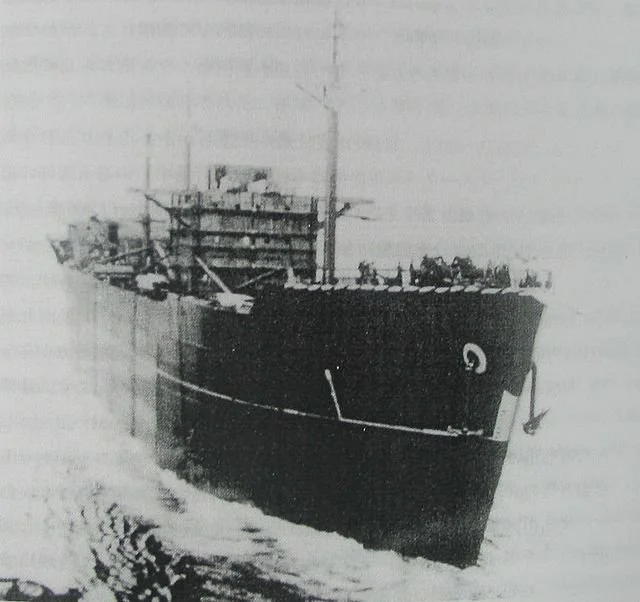
The Arisan Maru was a Japanese merchant vessel requisitioned by the military for wartime transport. Its technical specifications reflect the desperate state of the Japanese merchant fleet late in the war:
Type/Class: The Arisan Maru was a Wartime Standard Cargo ship of the 2A Class, sometimes referred to as a Modified A class freighter. Designed in a state of "near panic" due to massive Japanese shipping losses by 1943, these vessels were built for rapid mass production rather than commercial economy, similar to the American Liberty Ships. To save time and materials, they were constructed with a reduced number of transverse frames and supporting beams, which severely weakened their overall hull integrity, and they lacked double bottom compartments. Engine failures were notoriously common.
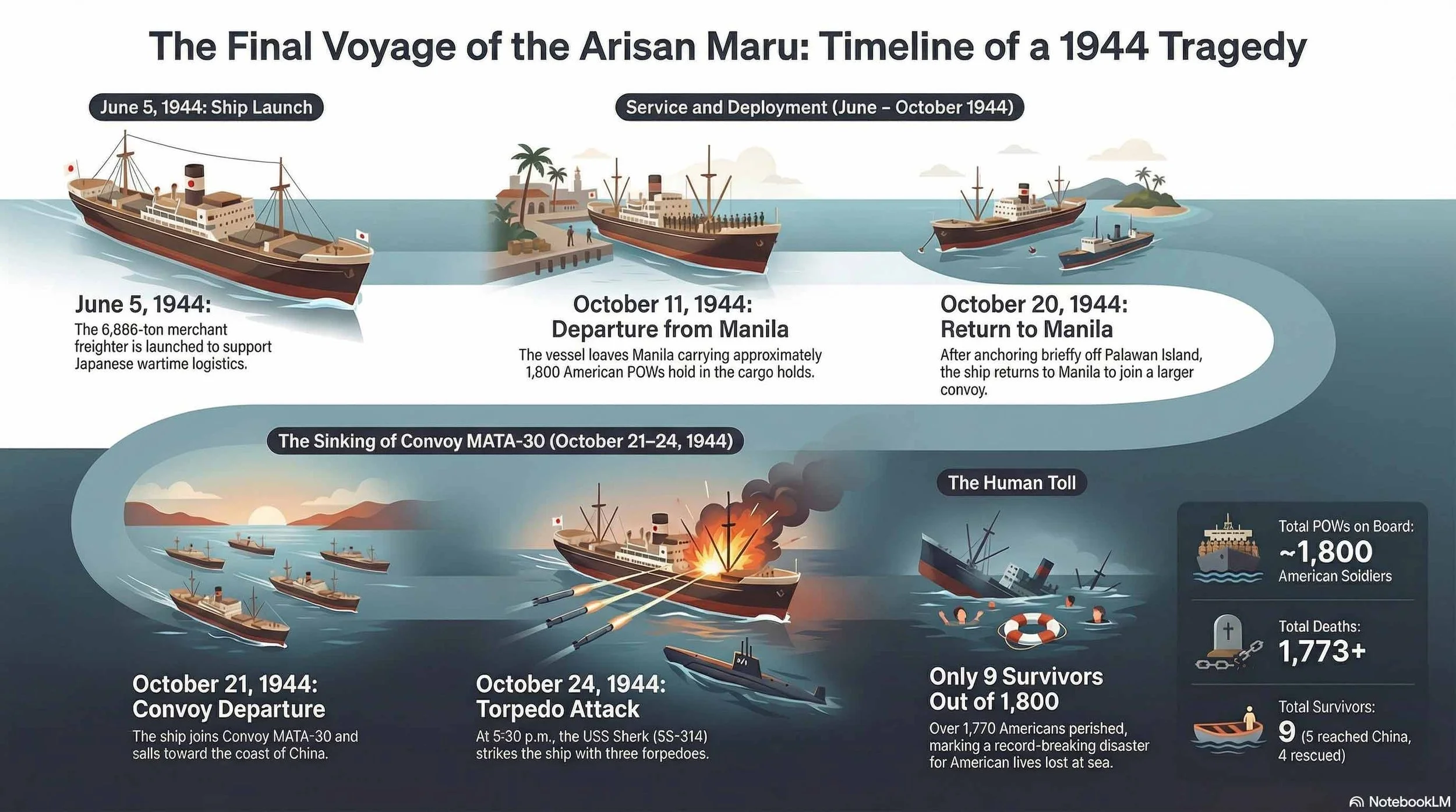
Date and Place Built: The ship was launched on June 5, 1944, and officially completed on June 22, 1944. Ships of this class were constructed in special yards set up specifically for mass production, with build times eventually reduced to as little as 36 days.
Owner: Operated by the Japanese merchant marine under the control of the Imperial Japanese government.
Tonnage: 6,886 gross tons. (The standard 2A class generally displaced 6,600 gross register tons).
Length: 448 feet and 8 inches (136.75 meters).
Beam (Width): 59 feet and 8 inches (18.19 meters).
Draught: 36 feet and 5 inches (11.10 meters).
Displacement: The standard 2A class vessels had a deadweight tonnage of 11,200 tons.
Engine: 1-shaft steam turbine with 3 boilers, with the machinery spaces moved to the rear of the ship to reduce the length of the shafts.
Power: 3,500 shaft horsepower (shp).
Speed: Maximum speed of 13 knots.
Range: 4,000 nautical miles at a cruising speed of 9.5 knots.
Last Voyage
The final voyage of the Arisan Maru began in the fall of 1944, as American forces were closing in on the Philippines. The Japanese desperately sought to evacuate surviving POWs to the home islands to be used as slave labor. On October 11, 1944, approximately 1,781 to 1,800 Allied POWs—the vast majority of them American military personnel who had survived the Bataan Death March, the fall of Corregidor, and the brutal camps at Cabanatuan and Bilibid—were herded into the sweltering cargo holds of the Arisan Maru in Manila.
The journey was erratic and agonizing. After departing Manila, the ship initially turned south toward Palawan Island, where it sat anchored off the coast for several days to avoid Allied air raids. On October 20, the ship returned to Manila to join Convoy MATA-30, finally departing the Philippines for the last time on October 21, 1944.
The conditions inside the holds during this prolonged embarkation were abominable. The POWs were packed together with virtually no ventilation, suffering from extreme heat that drove hundreds of men out of their minds. Rations were practically non-existent; each prisoner was given only about one teacup of rice twice daily and a single canteen of dirty water to drink per day. Sanitary facilities for the hundreds of suffering, dysentery-stricken men consisted of merely four 5-gallon buckets, creating an environment of unimaginable filth, disease, and despair.
The Attack and Loss
As Convoy MATA-30 sailed north through the South China Sea, it was unknowingly being tracked by Allied intelligence. On October 23, 1944, when the convoy was approximately 200 miles northwest of Luzon, two packs of United States submarines—totaling nine submarines—began to converge on the Japanese ships. Because the Arisan Maru bore no markings to indicate it was carrying prisoners of war, and because highly classified "Ultra" intelligence briefings deliberately withheld information about POW transports to protect the secrecy of Allied codebreaking, the American submarine commanders had no idea that thousands of their own men were trapped inside the freighter's hull.
The fatal blow came late in the afternoon of October 24, 1944. At approximately 5:00 p.m., an American submarine—either the USS Shark (SS-314) or the USS Snook (SS-279)—fired a spread of torpedoes at the Arisan Maru. Three torpedoes struck the vessel with devastating precision, effectively cutting the Arisan Maru in half. The structurally weak 2A class hull, devoid of double bottom compartments, could not withstand the impact. The crippled ship stayed afloat for a short time before finally sinking beneath the waves at approximately 7:00 p.m., at coordinates 20°31'N, 118°32'E, roughly 200 miles northwest of Luzon and south of Hong Kong. In a tragic twist of fate, the USS Shark, the submarine believed to be responsible for the fatal torpedoes, was also lost with all hands during this same combat action.
Casualties and Survivors
Miraculously, the torpedo strikes themselves did not directly kill the prisoners. Nearly all of the men survived the initial explosions and were able to scramble out of the darkened holds onto the deck, subsequently abandoning the sinking ship into the churning ocean. However, their fight for survival had only just begun.
As the POWs clung to debris, hatch boards, and makeshift rafts in the water, Japanese escort vessels in the vicinity actively refused to rescue them, leaving the men to their fate in the open sea. The result was an absolute massacre by exposure, dehydration, and drowning. Out of the nearly 1,800 prisoners aboard, an estimated 1,773 American servicemen perished.
Only nine men managed to survive the horrific ordeal. Five resourceful prisoners found one of the Arisan Maru's two lifeboats, managed to evade Japanese patrols, and successfully sailed across the sea to the coast of China. There, they were rescued by Chinese forces and eventually reunited with U.S. military personnel, returning safely to the United States. The remaining four survivors were recaptured by Imperial Japanese naval vessels; tragically, one of those four men died shortly after reaching land.