

Why Were Japanese Captors So Cruel?
A Historical Analysis of POW Treatment in World War II
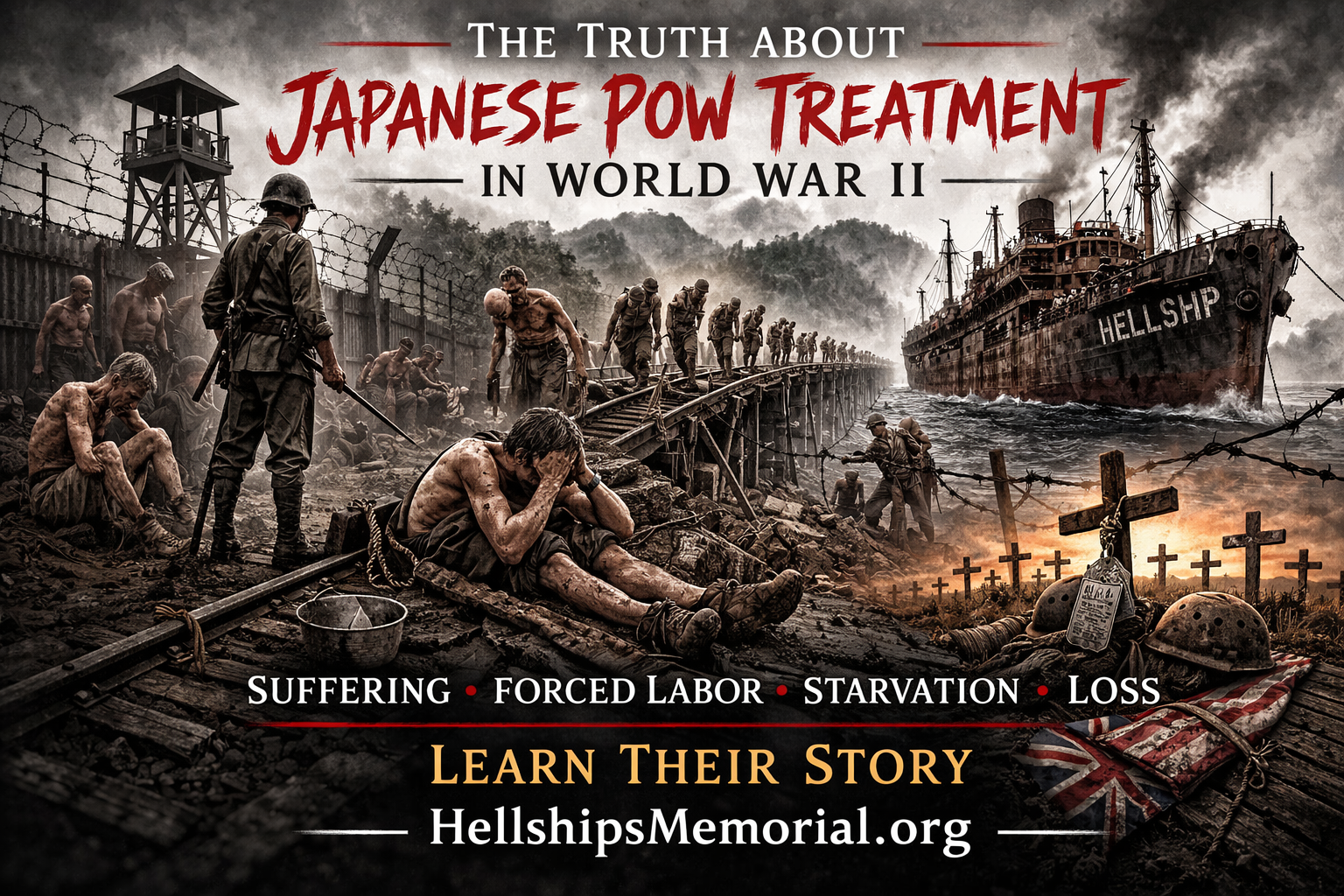
The treatment of Allied prisoners of war (POWs) by Japanese forces during World War II remains one of the most disturbing aspects of the Pacific War. Survivors’ accounts describe starvation, disease, forced labor, beatings, and, in many cases, death on a massive scale. Yet to understand why such cruelty occurred, it is necessary to move beyond moral outrage and examine the structural, cultural, and operational factors that shaped Japanese behavior. The brutality was not the result of a single cause, but rather a convergence of ideology, military doctrine, logistical collapse, and systemic failure.
1. Bushidō and the Cultural Stigma of Surrender
A central factor often cited is the influence of Bushidō, the traditional Japanese warrior code. Although the historical Bushidō of the samurai era was complex and evolved over centuries, the version promoted by the Imperial Japanese military in the 1930s and 1940s was highly simplified and militarized. It emphasized loyalty, honor, and—critically—the idea that surrender was dishonorable.
This belief had profound implications. Japanese soldiers were indoctrinated to view surrender as a moral failure worse than death. Consequently, Allied soldiers who surrendered were not seen as honorable enemies but as individuals who had forfeited their dignity. In this framework, POWs were often regarded as subhuman or unworthy of respect.
This cultural lens did not automatically produce cruelty, but it lowered the moral barrier to harsh treatment. If prisoners were not considered honorable combatants, then the obligations typically associated with their care became less compelling. The dehumanization of POWs was thus rooted, in part, in a deeply ingrained ideological perspective.
2. Absence of Legal and Institutional Constraints
Another key factor was Japan’s ambiguous relationship with international law governing the treatment of prisoners. While Japan had signed the 1907 Hague Convention, it had not ratified the 1929 Geneva Convention on Prisoners of War, which more clearly defined standards for POW treatment.
In practice, this meant that there was no strong institutional framework within the Japanese military for the humane management of prisoners. Policies were inconsistent, often vague, and left to the discretion of local commanders. Some officers attempted to follow international norms, but many did not, and enforcement mechanisms were weak or nonexistent.
Moreover, there was no entrenched tradition within the Japanese military of handling large numbers of POWs. Unlike Western armies, which had developed systems for prisoner administration during World War I, Japan entered World War II without a comparable institutional experience. The result was a system that was improvised, fragmented, and prone to abuse.
3. Logistical Collapse and Resource Scarcity
Material conditions played a decisive role. As the war progressed, Japan faced increasing shortages of food, medicine, fuel, and transport capacity. These shortages affected not only POWs but also Japanese troops themselves.
In many camps, guards and prisoners were competing for the same limited resources. Rations were often insufficient, and medical supplies were scarce. Under such conditions, POWs—already viewed as low priority—were frequently deprived of adequate food and care.
This scarcity does not excuse the brutality, but it helps explain its scale. Starvation, disease, and neglect were often the result of systemic shortages rather than deliberate policy alone. However, the distribution of resources reflected clear priorities: Japanese soldiers were to be sustained first, while POWs were expendable.
4. Forced Labor and Economic Imperatives
Japanese authorities made extensive use of POW labor to support the war effort. Prisoners were employed in constructing railways, airfields, roads, and industrial facilities, often under extremely harsh conditions. Projects such as the Burma-Thailand Railway became notorious for their high mortality rates.
From the Japanese perspective, POW labor was a practical necessity. The empire faced acute labor shortages, particularly in remote or contested areas. Utilizing prisoners was seen as an efficient way to supplement the workforce.
However, the conditions under which this labor was extracted were frequently brutal. Long hours, inadequate nutrition, and physical punishment were common. In many cases, productivity targets were prioritized over human survival. The economic logic of forced labor thus intersected with the ideological devaluation of prisoners, creating an environment where exploitation could proceed with little restraint.
5. Command Structure and Decentralized Authority
The structure of the Japanese military contributed to the variability—and often severity—of POW treatment. Authority was highly decentralized, and local commanders exercised significant autonomy. This meant that conditions could vary widely from one camp to another, depending on the attitudes and discipline of individual officers.
In some instances, relatively humane treatment was reported. In others, extreme brutality prevailed. The lack of standardized procedures and effective oversight allowed abusive practices to develop and persist.
Additionally, the culture within the military emphasized obedience and conformity. Lower-ranking soldiers were often reluctant to question or challenge orders, even when those orders involved mistreatment of prisoners. This dynamic reinforced a system in which cruelty could be carried out without accountability.
6. Training, Discipline, and the Normalization of Violence
The training methods used within the Imperial Japanese Army also played a role. Recruits were subjected to harsh discipline, including physical punishment, as part of their indoctrination. This environment normalized violence as a tool for enforcing authority.
When such individuals were placed in positions of power over prisoners, they often replicated the behaviors they had experienced. Abuse became a routine method of control, rather than an exception.
Furthermore, the stresses of combat—fatigue, fear, and the constant threat of death—could exacerbate these tendencies. In such conditions, the threshold for violence was lowered, and acts of cruelty became more frequent.
7. Racial Attitudes and Wartime Propaganda
Wartime propaganda on all sides contributed to the dehumanization of the enemy, but in the Japanese case, this was often combined with a belief in the cultural and racial superiority of Japan within Asia. Allied soldiers, particularly Westerners, were portrayed as decadent or morally inferior, while Asian populations were often viewed through a hierarchical lens.
These attitudes reinforced the perception that POWs did not merit humane treatment. Dehumanization is a common feature of wartime psychology, but in this context, it was amplified by ideological narratives that justified harsh treatment as both necessary and appropriate.
8. Breakdown of Order in the War’s Final Stages
As Japan’s strategic situation deteriorated, conditions in POW camps often worsened. Supply lines were disrupted, communication with higher command became irregular, and the overall coherence of the military system began to break down.
In this environment, some guards abandoned restraint altogether. Others acted out of fear that advancing Allied forces would liberate the prisoners, leading to reprisals. In certain cases, this resulted in deliberate killings or forced evacuations under lethal conditions.
The final phase of the war thus saw an intensification of the factors that had already contributed to harsh treatment: scarcity, lack of oversight, and the erosion of discipline.
9. Individual Responsibility vs. Systemic Causes
It is important to distinguish between systemic factors and individual responsibility. Not all Japanese personnel treated POWs brutally, and there are documented cases of guards who showed restraint or even compassion. However, the overall pattern of abuse was widespread and cannot be attributed solely to a few individuals.
The system in which these individuals operated—shaped by ideology, institutional gaps, and wartime pressures—created conditions in which cruelty was more likely to occur and less likely to be punished. Understanding this system is essential for a comprehensive analysis.
Conclusion
The harsh treatment of Allied POWs by Japanese captors during World War II was the product of multiple, interrelated factors. Ideological beliefs about honor and surrender diminished the perceived humanity of prisoners. The absence of robust legal and institutional frameworks allowed inconsistent and often abusive practices to develop. Material shortages and economic demands further exacerbated conditions, while decentralized command structures and harsh training methods normalized violence.
These factors combined to create an environment in which cruelty could flourish. While moral judgment is unavoidable, a historical understanding requires careful attention to the underlying causes. By examining these causes, it becomes possible to move beyond simplistic explanations and gain a clearer view of how such outcomes were produced.
This analysis does not seek to excuse or justify the suffering endured by POWs. Rather, it aims to explain how a complex set of conditions—cultural, institutional, and operational—converged to produce one of the most troubling aspects of the Pacific War.